Preparing for a commercial driver’s license involves more than passing a written test and learning how to operate a truck. Many first-time applicants must also complete Entry-Level Driver Training before they can take the applicable CDL skills test.
Choosing the wrong course, using an unregistered provider, or completing theory without the required driving instruction can delay your progress.
ELDT stands for Entry-Level Driver Training. It is the federal training that certain first-time CDL applicants, license-upgrade applicants, and endorsement applicants must complete through a registered provider.
This guide explains who needs ELDT, what the training covers, whether it can be completed online, and what happens after completion. It will also help you choose training that supports both federal compliance and practical CDL preparation.
What Does ELDT Stand For?
ELDT stands for Entry-Level Driver Training. The Federal Motor Carrier Safety Administration established these regulations to create minimum training standards for people entering certain areas of commercial driving.
The current ELDT requirements took effect on February 7, 2022. They establish a federal baseline, although states may maintain additional requirements that exceed the federal standards.
ELDT is different from an ELD. An ELD is an electronic logging device used to record a driver’s hours of service. ELDT refers to required driver training.
Who Is Required to Complete ELDT?
You generally need ELDT when you are:
- Obtaining a Class A CDL for the first time
- Obtaining a Class B CDL for the first time
- Upgrading from a Class B CDL to a Class A CDL
- Obtaining a passenger endorsement for the first time
- Obtaining a school bus endorsement for the first time
- Obtaining a hazardous materials endorsement for the first time
These requirements apply to covered applicants before they take the applicable CDL skills or endorsement knowledge test.
Do You Need ELDT?
| Your goal | Is ELDT generally required? |
| Obtain a first Class A CDL | Yes |
| Obtain a first Class B CDL | Yes |
| Upgrade from Class B to Class A | Yes |
| Add a first H, P, or S endorsement | Yes |
| Renew an existing CDL of the same class | Generally no |
| Obtain training for a license class previously held | Generally no |
Some applicants qualify for exceptions. For example, a person who currently holds or previously held the same CDL class generally does not need ELDT for that license type. Applicants with unusual licensing histories should use the official FMCSA applicability tool and confirm their situation with their state licensing agency.
What Does ELDT Training Include?
ELDT can include two components:
- Theory instruction
- Behind-the-wheel instruction
The requirements depend on the CDL class or endorsement being pursued.
| Training component | What it covers | How it is completed |
| Theory | Vehicle systems, inspections, safety rules, hazards and operating knowledge | Classroom or approved online instruction |
| Behind-the-wheel | Vehicle control, range exercises and public-road operation | In person in an appropriate commercial vehicle |
ELDT Theory Training
Theory instruction builds the knowledge needed to operate a commercial vehicle safely. Depending on the curriculum, students may study:
- Vehicle controls and systems
- Pre-trip and post-trip inspections
- Safe operating procedures
- Railroad crossings
- Hazard awareness
- Hours-of-service rules
- Fatigue and driver wellness
- Cargo responsibilities
- Vehicle malfunctions and reporting
A student must complete the applicable curriculum and score at least 80 percent on the theory assessment.
Theory may be delivered online, but it must come from a provider listed on the FMCSA Training Provider Registry.
Students seeking structured theory and test preparation can explore MT Training Center’s CDL Prep Program. The program includes ELDT theory, commercial vehicle safety, inspections, and CDL testing preparation. MT Training Center currently lists it as an 80-clock-hour program.
Behind-the-Wheel Training
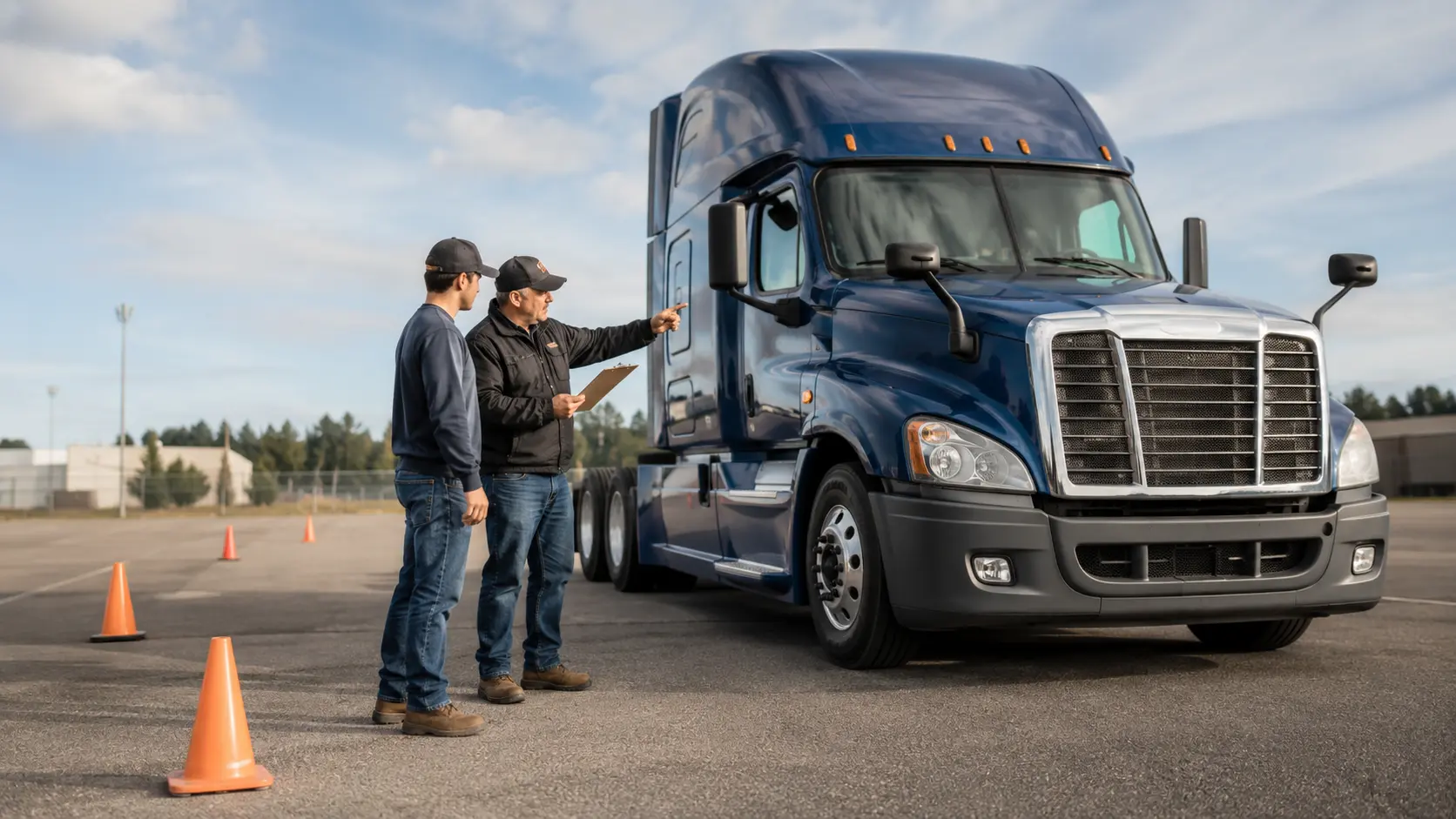
Behind-the-wheel training develops the practical skills needed to control a commercial vehicle. It generally includes range instruction and public-road driving.
Students may practice:
- Pre-trip inspections
- Basic vehicle control
- Straight-line and offset backing
- Turning and lane positioning
- Speed and space management
- Railroad crossing procedures
- Entering and exiting roadways
- Responding to traffic and road conditions
This portion cannot be replaced by an online course or simulator alone. The instructor must determine that the student has demonstrated proficiency in the required skills.
Students preparing to operate combination vehicles can review MT Training Center’s Class A CDL training program. It includes ELDT theory and practical preparation involving inspections, backing, vehicle control, and road safety. The school currently lists the program as 160 clock hours.
Those planning to operate qualifying single commercial vehicles can explore Class B CDL Training, which MT Training Center currently lists as a 240-clock-hour program.
How Many Hours of ELDT Are Required?
Federal ELDT regulations do not set one universal minimum number of theory or behind-the-wheel hours.
Theory completion is based on covering the required curriculum and passing the assessment. Behind-the-wheel completion is based on the instructor’s evaluation of the student’s proficiency. A state may impose additional requirements.
This means students should not choose a program based only on the shortest advertised duration. Consider whether the training provides enough instructor support, vehicle access, inspection practice, backing exercises, and public-road preparation for your needs.
Can ELDT Be Completed Online?
ELDT theory can be completed online through an eligible registered provider. Required behind-the-wheel training must be completed in person.
This distinction matters because some online courses provide theory only. That may meet the ELDT requirement for a first hazardous materials endorsement, which requires theory but not ELDT behind-the-wheel instruction. It does not normally complete all requirements for first-time Class A or Class B applicants.
Before enrolling, ask:
- Does this course include theory only?
- Is behind-the-wheel training included?
- Does it cover my CDL class or endorsement?
- Is the provider listed on the Training Provider Registry?
- Who submits my completion record?
What Is the FMCSA Training Provider Registry?
The Training Provider Registry, or TPR, is the federal system that lists eligible ELDT providers and stores completed training records.
Applicants must receive required ELDT from a provider registered for the applicable training type. The provider then submits the student’s completion information electronically.
Providers are required to submit certification information by midnight of the second business day after training is completed. Students can use the TPR’s record-checking tool to confirm that their information has been reported.
What Happens After You Complete ELDT?
Completing ELDT does not automatically give you a CDL.
The general process is:
- Complete the required theory and behind-the-wheel training.
- Meet the provider’s assessment and proficiency standards.
- Have the provider report your completion.
- Confirm that the state can access your training record.
- Pass the applicable knowledge or CDL skills tests.
- Complete any remaining state and federal requirements.
Texas applicants can review MT Training Center’s guide on how to get a Class A CDL in Texas for a broader explanation of the licensing process.
Why Does ELDT Matter for CDL Students?
ELDT matters because commercial driving requires both knowledge and practical judgment. New drivers must understand vehicle inspections, safety regulations, traffic risks, operating limitations, and the responsibilities of controlling a large commercial vehicle.
It also matters from a career-preparation perspective. The U.S. Bureau of Labor Statistics projects about 237,600 openings for heavy and tractor-trailer truck drivers each year, on average, from 2024 through 2034. Many openings are expected because existing workers will change occupations or leave the workforce.
ELDT creates a starting point, but minimum compliance should not be confused with complete CDL preparation.
A broader CDL program may provide additional support with:
- State test preparation
- Vehicle inspections
- Backing and maneuvering
- Public-road confidence
- Professional driver responsibilities
- Preparing for entry-level commercial driving
How to Choose an ELDT Training Provider
Before paying for training, verify:
- The provider appears on the Training Provider Registry.
- The program matches your required CDL class or endorsement.
- You know whether it includes theory, driving instruction, or both.
- The school explains how practical proficiency is evaluated.
- The training uses the type of vehicle relevant to your goal.
- Tuition inclusions and additional costs are clear.
- The provider explains when completion records are submitted.
- Current schedules and locations fit your availability.
- Admissions and student-support resources are available.
MT Training Center offers several CDL pathways for different goals. In addition to CDL Prep, Class A, and Class B options, its Advanced CDL Training for the Entrepreneur combines Class A preparation with trucking business topics such as compliance, insurance, operating expenses, bookkeeping, and equipment planning.
Program schedules and availability can change, so confirm current details with admissions before enrolling.
Common ELDT Mistakes to Avoid
Avoid these mistakes during the CDL process:
- Assuming ELDT completion means you have earned a CDL
- Enrolling without verifying the provider on the TPR
- Purchasing theory-only training when driving instruction is required
- Choosing the wrong CDL class for your career goal
- Scheduling a test before your record is submitted
- Ignoring additional state requirements
- Comparing programs only by price or length
- Assuming training guarantees a passing test result or employment
Take the Next Step Toward CDL Training
Before selecting a course, identify the CDL class or endorsement you need, confirm whether ELDT applies, verify the provider, and determine whether the program includes all required training components.
MT Training Center offers Class A, Class B, CDL Prep, and advanced CDL education options for students with different goals. Review the programs carefully or schedule a campus tour to discuss which path may fit your training needs.
Frequently Asked Questions About ELDT
Do I need ELDT before getting a commercial learner’s permit?
Federal ELDT rules generally require applicable Class A or Class B training before the CDL skills test, not before the initial CLP knowledge test. State procedures or additional requirements may differ.
Is ELDT required for both Class A and Class B CDLs?
Yes. It generally applies when obtaining either license class for the first time and when upgrading from Class B to Class A.
Can ELDT be completed entirely online?
No. Theory may be completed online through a registered provider, but required behind-the-wheel instruction must be completed in person.
Is there a minimum number of driving hours?
Federal regulations do not set one universal minimum. Behind-the-wheel completion is based on demonstrated proficiency, although states may require additional training.
What score is required for ELDT theory?
Students must earn at least 80 percent on the applicable theory assessment.
Does completing ELDT mean I have earned a CDL?
No. You must still pass the applicable state tests and meet all remaining licensing requirements.
How does the state know I completed ELDT?
Your provider submits your completion information to the Training Provider Registry. The state licensing agency checks the record before administering the applicable test.
Does ELDT expire?
Federal ELDT regulations do not specify a general expiration period for completed training. However, learner’s permits, medical certificates, state tests, and other licensing steps may have separate expiration dates.
Who may be exempt from ELDT?
A driver who currently holds or previously held the same CDL class may not need ELDT for that class. Other limited exceptions may apply, so applicants should check the FMCSA applicability tool and their state’s requirements.