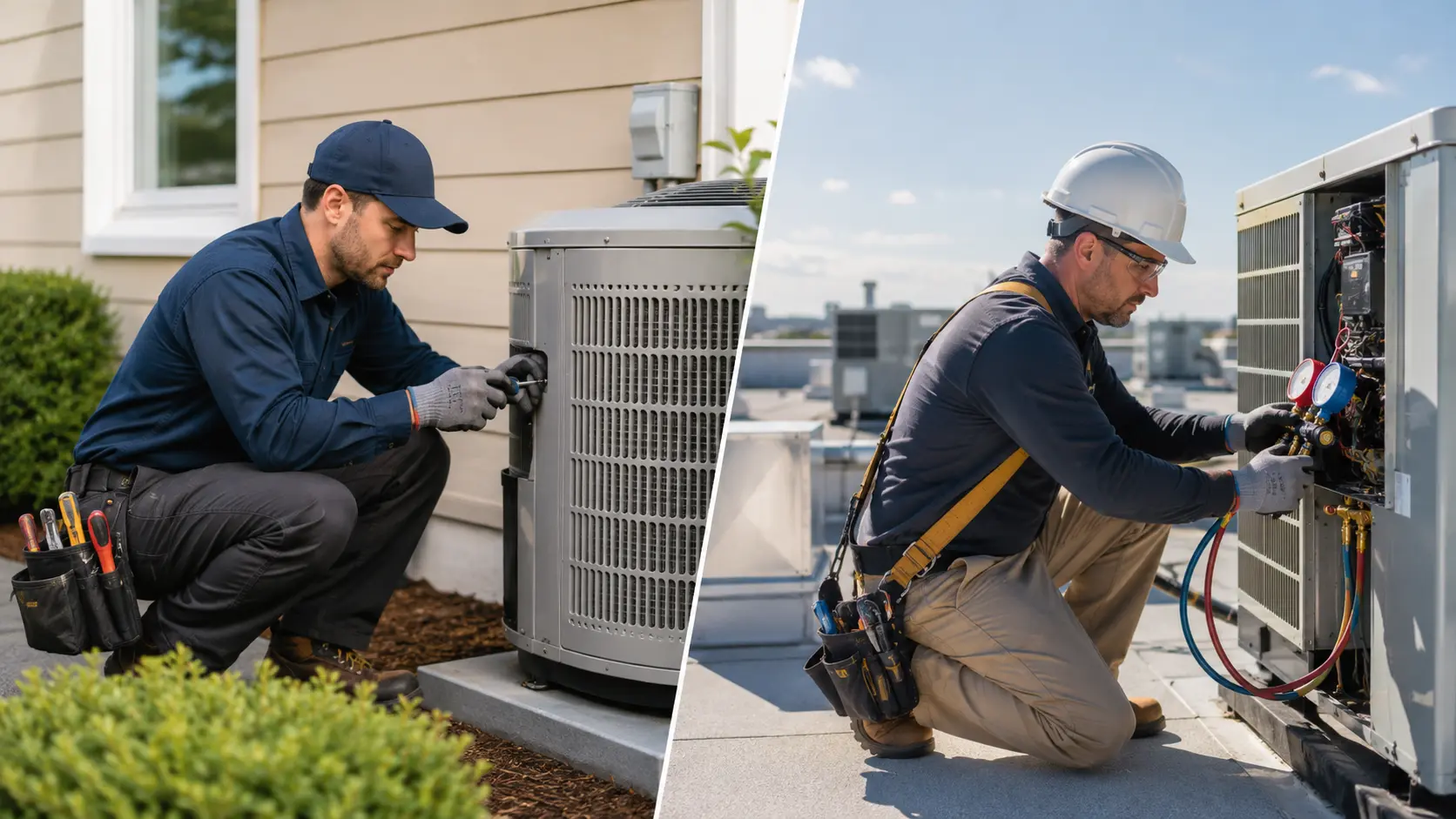
Choosing an HVAC career is about more than learning how to repair heating and cooling systems. It is also about deciding what type of work environment, equipment, customers, and career opportunities match your goals.
Many people entering the HVAC field ask:
Should I become a residential HVAC technician or a commercial HVAC technician?
Both career paths involve heating, ventilation, air conditioning, and refrigeration systems. Both require knowledge of electrical systems, diagnostics, safety, and equipment operation. However, the daily responsibilities, technical challenges, and work environments can be very different.
Residential HVAC technicians primarily work on heating and cooling systems found in homes and smaller buildings. Commercial HVAC technicians typically work on larger systems designed for businesses, schools, hospitals, warehouses, and other facilities.
Understanding the difference between residential and commercial HVAC careers can help you choose the path that fits your interests, skills, and long-term career goals.
Residential vs Commercial HVAC Careers: Quick Comparison
| Category | Residential HVAC Career | Commercial HVAC Career |
| Main Work Location | Homes, apartments, smaller residential buildings | Offices, schools, hospitals, warehouses, commercial facilities |
| Main Customers | Homeowners | Businesses, facility managers, property managers |
| Equipment | Furnaces, central AC systems, heat pumps, residential units | Rooftop units, chillers, boilers, large HVAC systems |
| Daily Work | Repairs, installations, maintenance calls | Diagnostics, maintenance, complex system repairs |
| Customer Interaction | Frequent homeowner communication | More interaction with facility teams |
| System Complexity | Smaller systems | Larger and more advanced systems |
| Career Opportunities | Service technician, installer, business owner | Commercial technician, controls specialist, facility technician |
What Is a Residential HVAC Career?
A residential HVAC technician focuses on keeping homes comfortable by installing, maintaining, and repairing heating and cooling systems.
Most residential HVAC work involves systems designed for individual homes or small residential properties.
Common Responsibilities of Residential HVAC Technicians
A residential HVAC technician may:
- Install air conditioning systems
- Repair furnaces and heating equipment
- Service heat pumps
- Replace thermostats
- Diagnose airflow problems
- Perform seasonal maintenance
- Troubleshoot electrical issues
- Check refrigeration components
A typical day may include visiting multiple homes, identifying HVAC problems, explaining solutions to homeowners, and completing repairs.
What Makes Residential HVAC Different?
Residential HVAC technicians often work directly with homeowners. This means technical skills are only part of the job.
A successful residential technician also needs strong:
- Communication skills
- Customer service abilities
- Time management
- Problem-solving skills
For example, a homeowner may not understand why their air conditioner is not cooling properly. The technician needs to identify the issue while also explaining the problem and recommended solution clearly.
Residential HVAC can be a good fit for people who enjoy variety, independent work, and helping customers solve everyday comfort problems.
What Is a Commercial HVAC Career?
A commercial HVAC technician works with larger heating and cooling systems designed for businesses and public facilities.
Commercial systems are built to manage temperature, airflow, and comfort across much larger spaces compared to residential properties.
Common Responsibilities of Commercial HVAC Technicians
Commercial HVAC technicians may work on:
- Rooftop HVAC units
- Commercial refrigeration systems
- Boilers
- Chillers
- Large ventilation systems
- Building automation controls
- Complex heating and cooling equipment
Commercial HVAC technicians may work in environments such as:
- Schools
- Hospitals
- Hotels
- Retail stores
- Office buildings
- Manufacturing facilities
- Warehouses
Unlike residential work, commercial HVAC problems can affect entire buildings, which means technicians often handle larger systems and more complex troubleshooting.
Residential vs Commercial HVAC: Key Career Differences
1. Equipment Size and System Complexity
The biggest difference between residential and commercial HVAC careers is the size and complexity of the equipment.
Residential technicians usually work with systems designed for individual homes.
Examples include:
- Central air conditioning units
- Furnaces
- Heat pumps
- Residential ventilation systems
Commercial technicians often work with:
- Larger heating and cooling equipment
- Multiple-zone systems
- Advanced controls
- Large refrigeration systems
Because commercial systems are larger, technicians often need deeper diagnostic skills to identify problems and maintain system performance.
2. Difference in Daily Work Environment
Your daily routine can look very different depending on the HVAC path you choose.
Residential HVAC Technician Daily Work
A residential technician may:
- Travel between customer homes
- Diagnose comfort problems
- Repair or replace equipment
- Explain issues to homeowners
- Perform installations and maintenance
The work is often fast-paced because technicians may complete several service calls in one day.
Commercial HVAC Technician Daily Work
A commercial technician may:
- Inspect large HVAC systems
- Perform scheduled maintenance
- Troubleshoot equipment failures
- Work with facility teams
- Repair complex components
Commercial projects may require longer troubleshooting processes because multiple systems and components can affect performance.
3. Customer Interaction Differences
Customer interaction is another major difference between residential and commercial HVAC careers.
Residential HVAC Customer Interaction
Residential technicians communicate directly with homeowners.
They often need to:
- Explain repairs
- Recommend maintenance
- Answer questions
- Build customer trust
Strong communication skills can be a major advantage.
Commercial HVAC Customer Interaction
Commercial technicians usually work with:
- Facility managers
- Maintenance supervisors
- Business owners
- Building operators
The conversations are often more focused on:
- Equipment performance
- Maintenance schedules
- System reliability
- Building operations
Is Commercial HVAC Harder Than Residential HVAC?
Many people assume commercial HVAC is automatically harder than residential HVAC.
The reality is that both career paths require technical knowledge, but the challenges are different.
Commercial HVAC often involves:
- Larger equipment
- More complex controls
- Advanced troubleshooting
- Multiple system components
Residential HVAC requires technicians to:
- Diagnose problems quickly
- Understand different home systems
- Communicate effectively with customers
- Complete repairs efficiently
The better question is not:
Which one is harder?
The better question is:
Which type of HVAC work matches your interests and career goals?
Residential vs Commercial HVAC Salary: Which Career Pays More?
One of the most common questions students ask is:
Does commercial HVAC pay more than residential HVAC?
Commercial HVAC careers may offer higher earning potential because technicians often work with larger systems and specialized equipment.
However, income depends on several factors, including:
- Experience
- Location
- Certifications
- Employer
- Technical skills
- Specialization
Experienced residential HVAC technicians can also build successful careers through:
- Lead technician roles
- Service management
- HVAC company ownership
The highest-value technicians are usually those who continue improving their technical knowledge and developing specialized skills.
Residential HVAC Career Growth Opportunities
Residential HVAC offers several career advancement opportunities.
A typical career path may look like:
HVAC Apprentice
↓
Residential HVAC Technician
↓
Lead Technician
↓
Service Manager
↓
HVAC Business Owner
Residential HVAC can be especially attractive for people interested in entrepreneurship because many HVAC companies begin by serving homeowners.
Commercial HVAC Career Growth Opportunities
Commercial HVAC provides opportunities to specialize in advanced systems and larger projects.
A possible career path may look like:
HVAC Apprentice
↓
Commercial HVAC Technician
↓
Senior Technician
↓
Controls Specialist
↓
Project Manager or Facility Technician
Commercial technicians can develop expertise in areas such as controls, refrigeration, and large mechanical systems.
What Skills Are Needed for Residential and Commercial HVAC Careers?
Although the work environments are different, both career paths require a strong technical foundation.
Important HVAC skills include:
Refrigeration Knowledge
Technicians need to understand:
- Refrigeration cycles
- Compressors
- Condensers
- Evaporators
- Refrigerant systems
Electrical Skills
HVAC systems depend heavily on electrical components.
Technicians learn about:
- Circuits
- Motors
- Relays
- Capacitors
- Controls
- Electrical troubleshooting
Diagnostic Skills
Modern HVAC technicians need more than the ability to replace parts.
They need to understand:
- How systems operate
- How components work together
- How to identify the cause of problems
Safety Knowledge
HVAC professionals work with electrical systems, refrigerants, heating equipment, and mechanical components, making safety training essential.
How HVAC Training Prepares You for Residential and Commercial Careers
Before choosing a specialty, HVAC technicians need a strong understanding of the fundamentals.
A quality HVAC training program should cover:
- Refrigeration principles
- Heating systems
- Electrical controls
- Equipment operation
- Diagnostics
- Safety procedures
MT Training Center’s Advanced Refrigeration, Heating and Air Conditioning (HVAC-R) Program is designed to help students build foundational HVAC-R skills related to both residential and commercial equipment. The program includes training in refrigeration theory, electrical controls, gas and electric heating, safety, diagnostics, and repair preparation.
The program combines classroom learning with lab-based training to help students understand how HVAC systems operate and how technicians approach troubleshooting.
Which HVAC Career Path Is Right for You?
The right choice depends on the type of work you enjoy.
Residential HVAC May Be a Good Fit If You:
- Enjoy working with people
- Like solving different problems every day
- Prefer smaller systems
- Want more customer interaction
- Are interested in starting your own HVAC business
Commercial HVAC May Be a Good Fit If You:
- Enjoy technical challenges
- Like working with larger systems
- Prefer complex troubleshooting
- Want specialization opportunities
- Enjoy working on commercial equipment
Can You Move From Residential HVAC to Commercial HVAC?
Yes.
Many HVAC professionals develop experience in one area and later expand into another.
A strong foundation in:
- Refrigeration
- Electrical systems
- Heating and cooling principles
- Diagnostics
- Safety
can help technicians transition between residential and commercial environments.
This is why learning HVAC fundamentals is important before specializing.
Start Building Your HVAC Career With Practical Training
Choosing between residential and commercial HVAC is an important career decision, but both paths begin with the same foundation: understanding how heating, cooling, refrigeration, electrical systems, and diagnostics work together.
MT Training Center’s HVAC-R program helps students develop practical skills through structured instruction focused on refrigeration, electrical controls, heating systems, safety, and HVAC troubleshooting fundamentals.
For students exploring HVAC careers, learning the fundamentals first can create more opportunities to choose the path that fits their goals.
Internal linking opportunities:
- HVAC-R Program
- Vocational Training Programs
- Admissions
- Schedule a Tour
Frequently Asked Questions
What is the difference between residential and commercial HVAC careers?
Residential HVAC technicians mainly work on heating and cooling systems in homes, while commercial HVAC technicians work on larger systems used in businesses, schools, hospitals, and other facilities.
The biggest differences are equipment size, system complexity, customer type, and work environment.
Is commercial HVAC harder than residential HVAC?
Commercial HVAC often involves larger equipment and more complex systems, but residential HVAC also requires strong troubleshooting and customer service skills.
Both careers require technical training and hands-on experience.
Which HVAC career pays more, residential or commercial?
Commercial HVAC may offer higher earning potential because technicians often work with larger systems and specialized equipment. However, income depends on experience, location, skills, certifications, and career progression.
Should I choose residential or commercial HVAC as a beginner?
Both paths can be good starting points. Beginners should focus on building strong HVAC fundamentals before choosing a specialty.
Residential HVAC may suit people who enjoy customer interaction, while commercial HVAC may suit people who prefer complex systems and technical challenges.
Can a residential HVAC technician become a commercial HVAC technician?
Yes. Many technicians transition between residential and commercial HVAC as they gain experience and develop additional technical skills.
What skills do you need for a commercial HVAC career?
Commercial HVAC technicians need knowledge of refrigeration systems, electrical controls, diagnostics, safety procedures, mechanical systems, and equipment troubleshooting.
What training is needed to become a residential or commercial HVAC technician?
HVAC technicians typically need training in refrigeration, heating systems, air conditioning, electrical controls, diagnostics, and safety practices.
Hands-on HVAC training programs can help students build the technical foundation needed for entry-level HVAC career opportunities.
Final Thoughts
Residential and commercial HVAC careers both offer opportunities in the skilled trades, but they provide different experiences.
Residential HVAC focuses on helping homeowners maintain comfort through service, repairs, and installations.
Commercial HVAC focuses on larger systems, advanced troubleshooting, and maintaining environments where businesses and organizations operate.
Neither path is automatically better. The right choice depends on your interests, strengths, and long-term career goals.
By building strong HVAC fundamentals through quality training, you can develop the skills needed to explore the career path that fits you best.