To become a CNC machinist, individuals typically need a high school diploma or equivalent, technical training, and hands-on experience operating CNC machines. Beginners can start through vocational programs, apprenticeships, or on-the-job training without a four-year college degree. Essential CNC machining skills include blueprint reading, precision measurement, machine setup, G-code programming, and quality control.
Training can take several months to two years, depending on the chosen pathway, while advanced skills develop with experience. Completing a CNC machinist training program can help beginners prepare for entry-level manufacturing jobs, with opportunities to advance into CNC programming, specialized machining, and supervisory roles.
What Does a CNC Machinist Do?
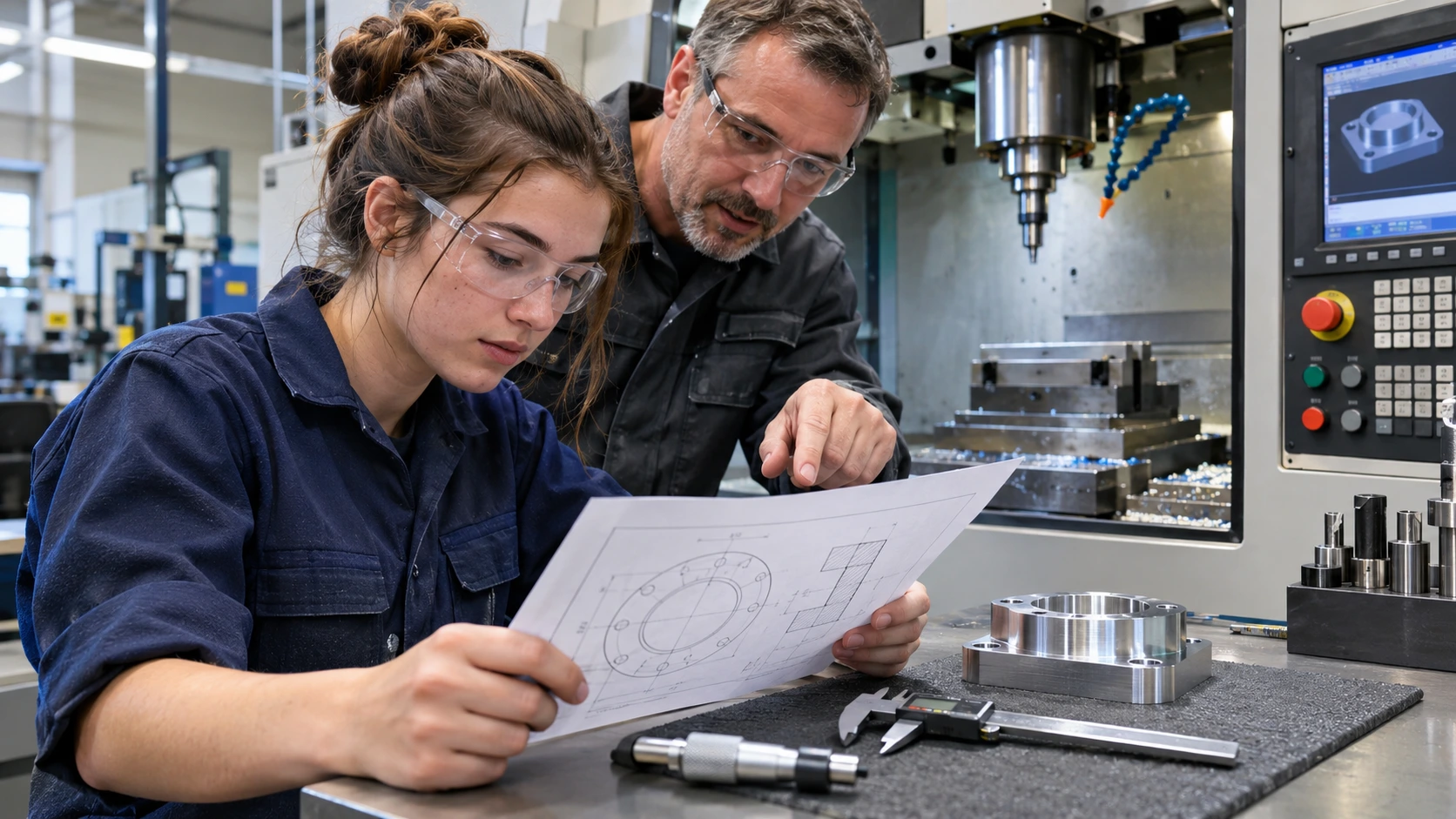
A CNC machinist sets up, operates, and monitors computer-controlled machines that manufacture precision components. Using Computer Numerical Control (CNC) technology, machinists interpret technical drawings, select tools, inspect finished parts, and adjust machining operations to meet engineering specifications.
CNC Machinist vs. CNC Operator vs. CNC Programmer
These three positions involve different levels of technical responsibility.
|
Position |
Main Responsibilities |
|
CNC machine operator |
Loads materials, monitors machine operation, and checks finished components |
|
CNC machinist |
Performs CNC machine setup, adjusts cutting parameters, and ensures part accuracy |
|
CNC programmer |
Creates and modifies programs controlling machine movements |
Understanding these differences helps beginners choose a realistic CNC machinist career path.
Common CNC Machines and Daily Job Responsibilities
A machinist works with machine tools such as a CNC milling machine, CNC lathe, and CNC machining center.
Typical responsibilities include:
- Reading engineering blueprints and production specifications.
- Performing machine programming adjustments.
- Selecting cutting tools and securing workpiece materials.
- Conducting workpiece inspection and quality control.
- Performing basic CNC machine maintenance.
- Monitoring production processes and manufacturing equipment.
These duties explain why practical skills matter throughout a machinist’s training.
How to Become a CNC Machinist in 6 Steps
To become a CNC machinist, beginners generally need foundational education, technical instruction, hands-on experience, and job-specific competency. The most practical route is to learn machine safety and measurement first, develop operating skills, and then pursue employment or additional credentials.
Step 1: Meet Basic Education Requirements
Most entry-level positions require a high school diploma or equivalent. Basic mathematics, mechanical aptitude, and familiarity with measurements provide a useful foundation.
An associate degree may support advancement, but it is not generally required to begin machinist training.
Step 2: Choose a CNC Machinist Training Path
Beginners can enroll in a technical school, attend a trade school, or enter an apprenticeship program.
A structured CNC machining training program combines technical education with guided equipment practice.
For example, MT Training Center’s CNC Machinist Program in DeSoto, Texas, provides 1,070 clock hours of instruction covering CNC mills, lathes, machining mathematics, and basic programming.
Step 3: Learn Essential CNC Machining Skills
Essential CNC machining skills include blueprint reading, tool selection, machining calculations, and precision measurement.
Students should also understand G-code programming for machine movements and M-code programming for auxiliary functions.
Step 4: Gain Hands-On CNC Machine Experience
Hands-on training develops the ability to prepare equipment, load materials, monitor cutting operations, and inspect components.
For example, a student might machine an aluminum part, measure its dimensions, and correct tool offsets when the finished component falls outside tolerance.
Step 5: Earn Relevant CNC Certifications
A CNC machinist certification can demonstrate technical competency, although independent certification is not universally mandatory.
Credentials from the National Institute for Metalworking Skills (NIMS) can help document specific machining abilities.
Step 6: Apply for Entry-Level CNC Machinist Jobs
Beginners should search for CNC operator jobs, machining assistants, and trainee positions.
Applicants with practical machining experience, measurement skills, and safety knowledge may qualify for entry-level opportunities even without extensive employment history.
CNC Machinist Training Options: Which Path Is Best?
The best CNC machinist training option depends on available time, finances, learning preferences, and career goals. Vocational training offers structured instruction, while apprenticeships and on-the-job training connect learning with workplace experience.
Trade School and Vocational CNC Training Programs
A trade school or technical school may offer CNC machinist courses covering machine setup, manufacturing technology, machining mathematics, and safety procedures.
Students can see our vocational training programs that combine classroom learning with practical preparation.
CNC Apprenticeships and On-the-Job Training
An apprenticeship program combines supervised work with structured instruction, often allowing participants to earn wages while learning.
Those researching how to get a CNC machinist apprenticeship can explore Apprenticeship.gov and local manufacturing employers.
Summarized Comparison Table: CNC Training Paths, Costs, and Time
|
Training Path |
Typical Time |
Cost Considerations |
Best For |
|
Trade school |
Several months to 2 years |
Tuition and fees |
Structured learning |
|
Apprenticeship |
Often 2–4 years |
Usually paid employment |
Learning while working |
|
On-the-job training |
Several months to multiple years |
Employer-dependent |
Entry-level workers |
|
Community college |
Often 1–2 years |
Tuition varies |
Certificate or degree seekers |
How much does CNC machinist training cost? Costs vary significantly by institution and program length. MT Training Center currently lists $30,500 in tuition and registration fees for its CNC program. Applicants should confirm current charges and financial aid eligibility directly.
What Skills Do You Need to Become a CNC Machinist?
A CNC machinist needs technical reading, mathematical skills, equipment knowledge, and the ability to produce accurate components. Employers particularly value workers who can interpret drawings, perform safe machine operations, identify defects, and maintain consistent production quality.
Blueprint Reading and Precision Measurement
Blueprint reading helps machinists interpret dimensions, surface specifications, and machining tolerances.
Knowledge of geometric dimensioning and tolerancing (GD&T) supports accurate inspection. Common measuring instruments include calipers and micrometers.
CNC Milling, Turning, and Machine Setup
A CNC milling machine removes material using rotating cutting tools, while a CNC lathe rotates material during cutting.
Machinists may encounter:
- Vertical machining center (VMC) and horizontal machining center (HMC) equipment.
- 3-axis CNC machine and 5-axis CNC machine configurations.
- CNC turning machine and CNC router applications.
- Milling operations, turning operations, and drilling operations.
- Specialized grinding operations and multi-axis CNC machining.
Different machines require different setup and operating techniques.
G-Code, M-Code, and CNC Programming Basics
CNC programming controls the movement and operating sequence of computer-controlled machines.
G-code programming commonly specifies tool movements, while M-codes control supporting functions. Operators must understand safe program execution before changing machine programming instructions.
CAD/CAM Software, Tooling, and Quality Control
CAD software supports computer-aided design, while CAM software supports computer-aided manufacturing by generating machining instructions.
Machinists also work with CNC cutting tools, material selection, and inspection procedures.
Common applications include aluminum machining, steel machining, and stainless steel machining, each requiring suitable cutting conditions.
Workplace Safety, Troubleshooting, and Problem-Solving
Safe metalworking requires workplace safety training, personal protective equipment (PPE), and established safety procedures.
Workers use safety glasses, appropriate hearing protection, and machine guarding. They must also follow applicable OSHA safety standards and industrial safety standards.
Troubleshooting equipment problems and performing preventive maintenance support reliable production machining.
How Long Does It Take to Become a CNC Machinist?
Becoming job-ready can take several months of focused instruction, while developing broader machining proficiency often requires years of experience. The timeline depends on training intensity, previous mechanical knowledge, and employer expectations.
Typical Training Timeline for Beginners
MT Training Center offers a 31-week daytime or 43-week evening program.
Other programs may have different schedules. Beginners should compare actual instructional hours rather than relying only on calendar duration.
How Experience and Training Affect Job Readiness
An entry-level machinist who can safely operate equipment, interpret drawings, and check dimensions may be prepared for supervised production work.
Independent setup, complex programming, and advanced machining generally require additional experience.
Do You Need a CNC Machinist Certification?
A CNC machinist certification is not universally required for entry-level employment. However, recognized machining credentials can demonstrate practical knowledge and help applicants document competencies.
NIMS Credentials and Other Recognized CNC Certifications
NIMS offers credentials covering CNC milling certification competencies, CNC turning certification competencies, setup, and programming.
These NIMS credentials can complement other machining credentials and manufacturing skills certification options.
Can You Become a CNC Machinist Without Certification?
Yes. Employers may hire applicants based on practical skills, prior experience, or completed training.
A school-issued Certificate of Completion differs from an industry-recognized certification. Candidates should confirm which qualifications employers prefer.
How Much Does a CNC Machinist Make?
A CNC machinist salary depends on experience, location, industry, and technical responsibilities.
According to the U.S. Bureau of Labor Statistics, the median annual wage for machinists was $58,750 in May 2025. This national figure is not an entry-level salary estimate.
Entry-Level CNC Machinist Salary and Earning Potential
An entry-level CNC machinist salary is generally lower than earnings for experienced workers.
CNC machinist hourly pay also varies by employer, shift premiums, overtime, and regional demand. The national median provides context but does not represent a starting offer.
Factors That Affect CNC Machinist Pay
An experienced CNC machinist may earn more by developing setup expertise, advanced programming abilities, or supervisory responsibilities.
The average machinist salary also differs across manufacturing sectors and local labor markets.
CNC Machinist Career Outlook and Advancement Opportunities
A CNC machining career can lead to several technical and supervisory positions. Advancement typically depends on experience, specialized machining skills, and the ability to handle increasingly complex manufacturing processes.
CNC Machining Jobs and Manufacturing Career Opportunities
CNC machinist job opportunities exist in machinery production, transportation equipment, aerospace supply chains, and metal fabrication.
The BLS projects approximately 30,400 annual openings for machinists and tool and die makers combined from 2025 to 2035, primarily due to workforce replacement.
Career Growth From CNC Operator to Setup Machinist and Programmer
A possible progression includes:
- CNC machine operator
- CNC setup technician or CNC setup machinist
- CNC programmer
- Machinist supervisor or production supervisor
Other career opportunities include quality control inspector, quality assurance technician, manufacturing technician, tool and die maker, and, with additional education, manufacturing engineer.
Experience in advanced manufacturing can support further technical career development.
How to Get Your First CNC Machinist Job Without Experience
Beginners can improve their chances of obtaining CNC machinist employment by demonstrating practical ability rather than relying exclusively on certificates. Employers need evidence that applicants can follow instructions, measure parts, operate safely, and recognize production problems.
Build a Job-Ready CNC Machining Skills Checklist
Before applying, candidates should be able to:
- Interpret basic part drawings.
- Use precision measuring tools.
- Identify common machine controls.
- Explain basic CNC machine setup.
- Follow safety procedures.
- Inspect parts against specifications.
These abilities form a practical foundation for manufacturing jobs.
Prepare a Resume and Demonstrate Practical Skills
A resume should highlight completed training, machine familiarity, technical projects, and relevant manufacturing experience.
For example, a candidate can describe producing a component from a drawing and checking its final dimensions.
Common Mistakes Beginners Should Avoid
Common mistakes include focusing only on programming, ignoring measurement skills, and applying exclusively for advanced positions.
New applicants should also consider the realities of working in a machine shop or manufacturing facility, including standing for extended periods, noisy manufacturing environments, and possible rotating shifts.
Key Takeaways: Your Roadmap to Becoming a CNC Machinist
The most effective route into CNC manufacturing combines foundational education, structured learning, practical machine experience, and realistic job expectations.
- A four-year degree is generally unnecessary for entry-level CNC work.
- Machinist training is available through schools, apprenticeships, and employers.
- Blueprint interpretation, measurement, and safety are essential.
- Certification can help but is not universally required.
- Practical experience supports career advancement.
- A strong CNC machinist career path can progress toward setup, programming, and supervision.
Frequently Asked Questions About Becoming a CNC Machinist
How Long Does It Take to Be a CNC Machinist?
Becoming a CNC machinist can take several months to two years of training, depending on the program and career pathway. Some beginners enter through on-the-job training, while others complete vocational programs.
MT Training Center offers a CNC Machinist Program with a 31-week daytime or 43-week evening schedule.
Is $30 an Hour Good for a CNC Machinist?
Yes, $30 an hour is generally a good wage for a CNC machinist, especially for someone with several years of experience.
At 40 hours per week, that equals approximately $62,400 annually before taxes, excluding overtime. Actual earning potential depends on location, employer, technical skills, and experience.
Is CNC Machining Well Paid?
CNC machining can be a well-paid skilled trade, particularly for machinists experienced in CNC programming, precision machining, and advanced machine setup.
According to the U.S. Bureau of Labor Statistics, the median annual wage for machinists was $58,750 in May 2025. Earnings vary based on experience, industry, and location.
Is Becoming a CNC Machinist Hard?
Becoming a CNC machinist can be challenging for beginners, but it is manageable with proper training and practice. Learning blueprint reading, precision measurement, CNC machine operation, and G-code programming takes time. Structured, hands-on training, such as the CNC Machinist Program at MT Training Center, can help beginners build these skills.
Can You Become a CNC Machinist With No Experience?
Yes, individuals can become CNC machinists without previous manufacturing experience. Entry-level CNC operator positions, apprenticeships, and vocational training programs provide opportunities to learn essential machining skills.
Employers may accept beginners who demonstrate basic technical knowledge, mechanical aptitude, and a willingness to learn.
Do You Need a College Degree to Become a CNC Machinist?
No, a college degree is not generally required to become a CNC machinist. Many employers accept candidates with a high school diploma or equivalent who have completed relevant training or gained practical experience. Vocational programs and apprenticeships offer alternative pathways into the profession.
Can You Learn CNC Machining on Your Own?
Yes, beginners can independently learn CNC programming fundamentals, G-code, blueprint reading, and basic machining concepts through online resources and simulation software. However, hands-on machine training is important for developing safe operating practices, machine setup skills, and practical manufacturing experience.
Is CNC Machining a Good Career?
Yes, CNC machining can be a good career for individuals interested in technology, manufacturing, and hands-on technical work.
It offers opportunities in aerospace, automotive manufacturing, metalworking, and precision component production. Career advancement can lead to CNC programming, machine setup, quality control, and manufacturing supervision.
What Is the Difference Between a CNC Machinist and a CNC Programmer?
A CNC machinist primarily sets up and operates CNC machines, monitors production, and inspects manufactured parts.
A CNC programmer creates or modifies the machine instructions used to manufacture components. Programming roles generally require more advanced knowledge of G-code, machining processes, and CAD/CAM software.