Before enrolling in HVAC school, most students want to know what the training actually looks like. Will you spend most of your time reading textbooks, or will you work directly with heating, cooling, electrical, and refrigeration equipment?
A well-designed HVAC technician certificate program combines both. Students learn the science behind indoor climate-control systems, then apply that knowledge through practical exercises involving tools, wiring, system components, maintenance, safety, and troubleshooting.
This guide explains the main subjects and hands-on skills typically covered in HVAC training, along with the certifications, workplace abilities, and entry-level career preparation you may gain.
What Do You Learn in an HVAC Technician Certificate Program?
An HVAC technician certificate program typically teaches heating and cooling fundamentals, refrigeration, electrical systems, airflow, controls, installation, maintenance, safety, and troubleshooting. Students may also practise using diagnostic tools, reading wiring diagrams, testing components, taking system measurements, and working with residential or commercial HVAC-R equipment.
Exact curricula vary by school, so prospective students should compare course content, lab access, program length, instructor support, and certification preparation before enrolling.
What Is an HVAC Technician Certificate Program?
An HVAC technician certificate program is a concentrated vocational training pathway designed to prepare students for entry-level work involving heating, ventilation, air conditioning, and refrigeration systems.
Unlike a four-year degree, a certificate program focuses primarily on technical concepts and job-related skills. It is also different from an apprenticeship, which usually combines paid workplace experience with classroom instruction over a longer period.
The U.S. Bureau of Labor Statistics reports that HVAC technicians typically need a postsecondary nondegree award, although routes into the occupation can vary. Technical-school and community-college HVAC programs commonly take six months to two years, followed by additional on-the-job learning.
MT Training Center offers an Advanced Refrigeration, Heating and Air Conditioning Program in DeSoto, Texas. The program combines classroom and laboratory instruction and is listed as 600 clock hours, with an 18-week day schedule and a 24-week evening schedule.
What Subjects Are Taught in HVAC Training?
HVAC systems combine mechanical, electrical, airflow, and refrigeration principles. For that reason, students study several connected subjects rather than learning only how to repair an air conditioner.
Heating, Cooling, and Ventilation Fundamentals
Students first need to understand how HVAC systems control temperature, humidity, airflow, and indoor comfort.
Common foundational topics include:
- Heat transfer
- Temperature and pressure
- Air movement
- Humidity
- Ventilation
- Indoor air quality
- Energy efficiency
- Residential and commercial system types
This theory matters because technicians need to understand why a system behaves a certain way before they can diagnose it accurately. For example, a cooling problem may result from a refrigerant issue, electrical failure, dirty coil, blocked filter, or restricted airflow.
HVAC systems do more than heat and cool a room. They also support ventilation, filtration, humidity control, and indoor air quality.
Heating Systems
HVAC students may learn how gas and electric heating systems operate, including:
- Furnaces
- Heat pumps
- Burners
- Ignition systems
- Heat exchangers
- Blower motors
- Heating controls
- Venting
- Safety switches
Practical training may involve identifying components, checking an ignition sequence, testing controls, inspecting airflow, and recognising unsafe operating conditions.
MT Training Center’s HVAC-R curriculum includes gas heating, electric heating, furnace operation, venting, controls, and diagnostic fundamentals.
Air-Conditioning Systems
Students also study the components that work together to remove heat from indoor spaces.
These may include:
- Compressors
- Condensers
- Evaporator coils
- Expansion devices
- Air handlers
- Thermostats
- Blower assemblies
- Refrigerant lines
- Heat pumps
Rather than treating each component as a separate part, students learn how airflow, refrigerant, and electrical controls affect the entire system.
For example, a compressor may be operating, but the building may still feel warm because of poor airflow, an incorrect refrigerant condition, or a failed control component.
Refrigeration Principles
Refrigeration is one of the most important technical subjects in HVAC-R training.
Students typically study the four main stages of the refrigeration cycle:
- Compression: The compressor raises the pressure and temperature of the refrigerant.
- Condensation: The refrigerant releases heat and changes from a vapour into a liquid.
- Expansion: Pressure drops as the refrigerant moves through an expansion device.
- Evaporation: The refrigerant absorbs heat and changes back into a vapour.
Students may also learn how to:
- Read pressure and temperature measurements
- Use manifold gauges
- Recognise refrigerant-system components
- Check for possible leaks
- Understand recovery procedures
- Evacuate a system
- Interpret superheat and subcooling
- Follow refrigerant-handling regulations
A strong program should explain not only how to take a reading, but also what that reading suggests about system performance.
HVAC Electrical Systems and Controls
One of the biggest surprises for new HVAC students is how much electrical work the trade involves.
Modern heating and cooling equipment depends on motors, thermostats, relays, capacitors, transformers, contactors, control boards, and safety switches. Students therefore need a working understanding of electrical theory.
Common topics include:
- Voltage
- Current
- Resistance
- Ohm’s law
- Series and parallel circuits
- Wiring diagrams
- Electrical safety
- Motors and capacitors
- Relays and contactors
- Low-voltage controls
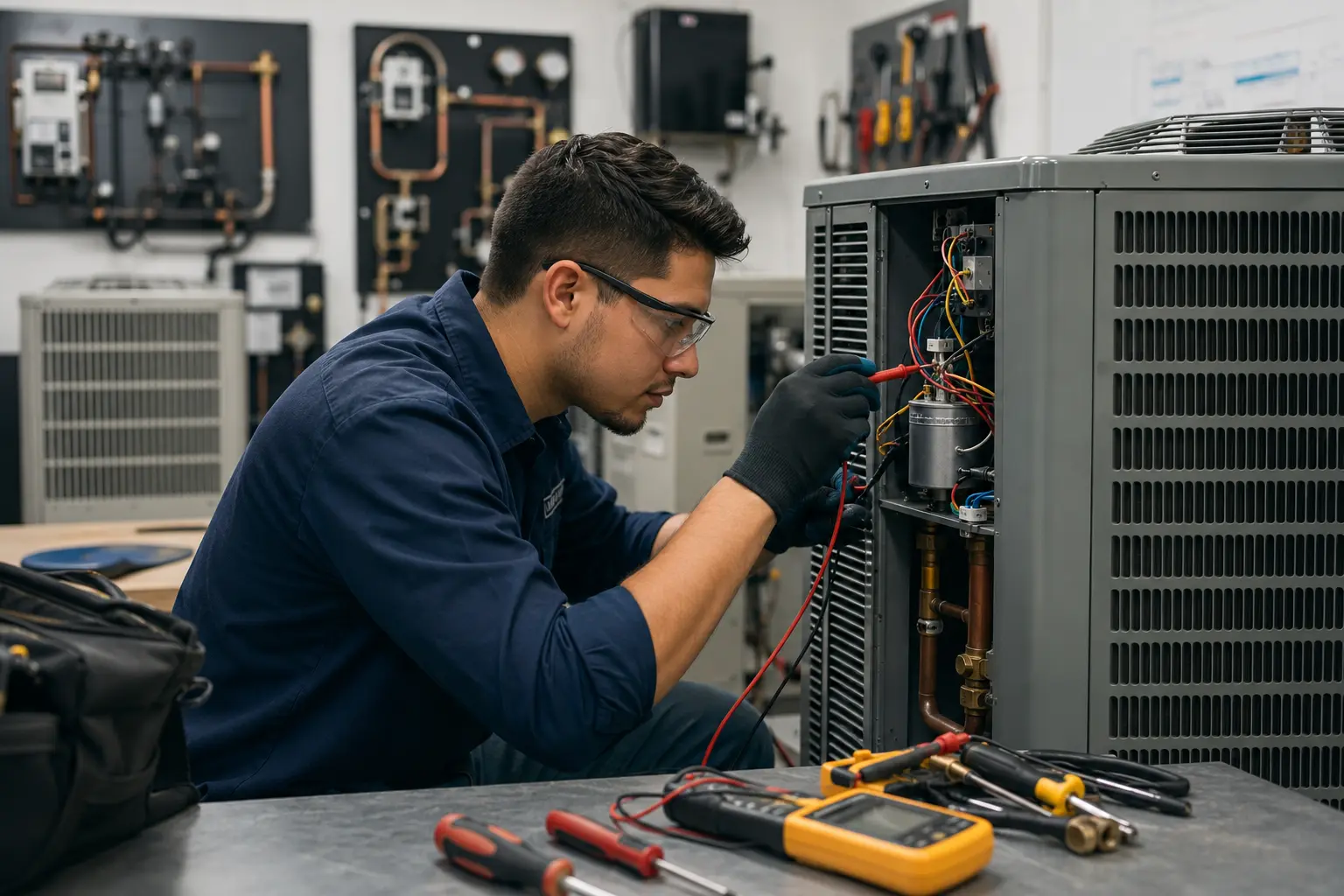
Hands-on activities may include:
- Reading a wiring diagram
- Using a multimeter
- Testing voltage and resistance
- Checking continuity
- Testing capacitors
- Tracing a circuit
- Identifying an open or failed component
The Bureau of Labor Statistics lists installing electrical components and wiring, inspecting systems, testing components, repairing defective parts, and keeping service records among common HVAC technician duties.
Airflow, Ductwork, and Indoor Air Quality
An HVAC system can have functioning electrical and refrigeration components and still perform poorly because of restricted or unbalanced airflow.
Students may learn about:
- Supply and return air
- Duct systems
- Filters
- Blower operation
- Registers and grilles
- Airflow restrictions
- Ventilation
- Humidity control
- Basic static-pressure concepts
- Indoor air quality
This helps students recognise problems such as dirty filters, blocked coils, damaged ducts, incorrect blower settings, or poor air distribution.
HVAC Installation and Maintenance
Certificate programs may introduce students to the steps involved in installing and maintaining HVAC equipment.
Training can include:
- Identifying proper component locations
- Preparing tubing
- Making basic electrical connections
- Checking condensate drainage
- Cleaning coils
- Replacing filters
- Inspecting motors and belts
- Performing equipment start-up checks
- Recording maintenance findings
- Following manufacturer instructions
Graduates may begin with basic installation and maintenance tasks while continuing to develop their skills under experienced technicians. The Bureau of Labor Statistics notes that newly hired technicians typically start with simpler duties before progressing to more complex work.
How Do HVAC Students Learn Troubleshooting?
Troubleshooting brings the entire curriculum together.
Instead of replacing parts based on guesswork, students learn to follow a logical process:
- Listen to the reported problem.
- Inspect the equipment.
- Confirm the symptoms.
- Check airflow, electrical, and mechanical conditions.
- Take accurate readings.
- Compare findings with expected operation.
- Identify the likely cause.
- Verify whether the correction worked.
- Document the service performed.
Students may practise identifying unusual sounds, failed controls, electrical faults, airflow restrictions, temperature differences, pressure irregularities, and damaged components.
MT Training Center’s program includes classroom and lab instruction designed to develop practical skills in refrigeration, heating, controls, safety, and HVAC-R system diagnosis.
Is HVAC Technician Training Hands-On?
Yes, HVAC training should include meaningful hands-on practice in addition to classroom instruction.
Students need opportunities to use tools, identify components, test circuits, take measurements, and work through simulated equipment problems. Reading about a capacitor or compressor is useful, but technical confidence develops when students can safely inspect and test actual equipment.
Hands-on activities may include:
- Inspecting heating and cooling equipment
- Reading wiring diagrams
- Testing electrical circuits
- Measuring temperatures
- Taking pressure readings
- Identifying failed components
- Practising preventive maintenance
- Diagnosing simulated system faults
- Following safe start-up and shutdown procedures
MT Training Center describes its HVAC-R program as a combination of classroom and laboratory training for students seeking practical preparation in the Dallas-Fort Worth area.
What Tools Do Students Use in HVAC School?
The exact equipment varies by program, but students may learn to use tools such as:
| Tool | Common purpose |
| Multimeter | Testing voltage, resistance, and continuity |
| Clamp meter | Measuring electrical current |
| Manifold gauge set | Reading refrigeration-system pressures |
| Thermometer | Measuring air and component temperatures |
| Vacuum pump | Removing air and moisture from a system |
| Recovery machine | Recovering refrigerant |
| Electronic leak detector | Locating possible refrigerant leaks |
| Tubing cutter | Preparing refrigerant tubing |
| Hand tools | Opening equipment and servicing components |
| Airflow tools | Evaluating air movement and system performance |
The goal is not simply to recognise each tool. Students should learn when to use it, how to use it safely, and how to interpret the result.
What Safety Skills Are Included?
Safety is a core part of HVAC training because technicians work around electricity, pressurised refrigerants, hot surfaces, gas-fired equipment, moving components, ladders, and heavy machinery.
Safety instruction may cover:
- Personal protective equipment
- Electrical hazards
- Lockout and tagout awareness
- Refrigerant safety
- Safe lifting
- Ladder safety
- Tool inspection
- Combustion and venting hazards
- Chemical handling
- Proper workplace housekeeping
HVAC technicians have a relatively high rate of occupational injuries and illnesses, according to the Bureau of Labor Statistics. Appropriate protective equipment and safe handling procedures help reduce risks from electrical components, chemicals, and heavy equipment.
Does HVAC School Prepare You for EPA Section 608 Certification?
Many HVAC programs include preparation for EPA Section 608 certification, but completing a school certificate does not automatically grant the federal credential.
EPA regulations require technicians who maintain, service, repair, or dispose of equipment that could release regulated refrigerants to pass an EPA-approved certification exam. The EPA recognises Type I, Type II, Type III, and Universal certification categories based on the equipment involved.
Students should ask each school:
- Whether EPA 608 preparation is included
- Whether testing is offered on campus
- Which certification types are covered
- Whether exam fees are included
- Which approved organisation administers the exam
MT Training Center advises prospective students to confirm its current EPA Section 608 preparation, testing, and certification details directly with the school. Its Certificate of Completion is separate from EPA certification, state registration, or an employer credential.
What Professional Skills Do HVAC Students Develop?
HVAC technicians work with equipment, but they also work with customers, supervisors, property managers, and other tradespeople.
A certificate program may help students develop:
- Problem-solving
- Technical communication
- Customer service
- Time management
- Service documentation
- Attention to detail
- Teamwork
- Professional conduct
- Tool organisation
- Following work orders
The Bureau of Labor Statistics identifies customer service, maths, mechanical ability, physical stamina, attention to detail, problem-solving, and technology skills as important qualities for HVAC technicians.
What Can You Do After Completing an HVAC Certificate Program?
A certificate program can help prepare graduates to pursue entry-level positions such as:
- HVAC technician helper
- Installation helper
- Maintenance technician
- Refrigeration technician helper
- Residential service assistant
- Commercial service assistant
- Facilities maintenance worker
- Preventive maintenance technician
Graduation does not guarantee employment, licensing, or independent technician status. Employers may require additional field experience, certification, registration, or supervised training.
The employment outlook remains positive. The Bureau of Labor Statistics projects employment of HVAC mechanics and installers to grow 8 percent from 2024 to 2034, with about 40,100 openings projected each year on average.
What Should You Look for in an HVAC Technician Program?
Before choosing a school, compare more than tuition or program length.
Look for:
- Classroom and laboratory training
- Heating, cooling, and refrigeration coverage
- Electrical and controls instruction
- Diagnostic practice
- Safety training
- EPA Section 608 preparation
- Residential and commercial equipment exposure
- Clear admissions requirements
- Transparent schedules and fees
- Financial-assistance information
- School accreditation or state approval
- Career-support resources
MT Training Center is accredited by the Council on Occupational Education and is approved and regulated by the Texas Workforce Commission Career Schools and Colleges Section. Its Advanced HVAC-R Program is listed among the programs approved to participate in applicable federal Title IV student-aid programs. Eligibility depends on the student and the applicable aid requirements.
Prospective students can review the HVAC-R program details, explore financial aid information, or speak with admissions about current schedules and requirements.
Is HVAC Training Right for You?
HVAC training may be a good fit if you enjoy understanding how systems work, solving practical problems, using tools, and working in changing environments.
The field also requires patience, physical activity, safety awareness, and a willingness to keep learning. HVAC technology continues to change as equipment becomes more energy-efficient, connected, and computer-controlled.
A certificate program cannot teach every system you will encounter during your career. It can, however, build a structured foundation in electrical systems, refrigeration, heating, airflow, maintenance, and diagnostics that supports continued workplace learning.
Students interested in hands-on HVAC-R training in DeSoto can explore MT Training Center’s program or contact the admissions team to discuss whether the curriculum fits their goals.
Frequently Asked Questions
What do you learn in an HVAC technician certificate program?
Students typically learn heating and cooling fundamentals, refrigeration, electrical circuits, controls, airflow, installation, maintenance, safety, and troubleshooting. Programs may also include hands-on practice with tools, wiring diagrams, diagnostic measurements, and residential or commercial HVAC-R equipment.
Do you need previous HVAC experience to enrol?
Many certificate programs are designed for beginners, but requirements vary by school. Students should review current admissions standards and consider whether they are comfortable working with electricity, mechanical components, tools, and physically active tasks.
Is HVAC training mostly hands-on?
HVAC training normally combines classroom theory with laboratory practice. Classroom instruction explains how systems operate, while hands-on training allows students to inspect equipment, use tools, test components, take measurements, and practise troubleshooting.
Do HVAC students learn electrical work?
Yes. Electrical systems are a major part of HVAC training. Students may learn basic electrical theory, wiring diagrams, motors, capacitors, relays, contactors, thermostats, transformers, and safe multimeter use.
Does HVAC school prepare you for EPA 608 certification?
Many programs include EPA Section 608 preparation, but the school certificate and EPA certification are separate credentials. Students must pass an examination administered by an EPA-approved certifying organisation to earn Section 608 certification.
How much maths is used in HVAC training?
HVAC technicians use practical maths for measurements, electrical calculations, system performance, temperature differences, pressure readings, and equipment requirements. Programs typically teach the calculations in the context of real HVAC tasks.
What jobs can you pursue with an HVAC certificate?
Graduates may pursue entry-level roles such as HVAC helper, installer helper, maintenance technician, service assistant, refrigeration helper, or facilities maintenance worker. Available positions and requirements vary by employer, experience, certification, and location.
Is an HVAC certificate the same as an HVAC licence?
No. A school certificate confirms successful completion of a training program. It is not automatically the same as a state licence, local registration, EPA Section 608 certification, or an employer-issued credential.