If you have ever stood in a hot house waiting for a technician to show up and fix the air conditioner, you already know something important: skilled HVAC-R workers are in short supply, and the people who have this training rarely stay unemployed for long. That is probably part of what brought you here. You are not just curious about heating and cooling systems. You are trying to figure out how soon you could actually be working in the field.
The short answer is that HVAC-R training generally takes between 6 months and 2 years for a certificate or diploma program, or 3 to 5 years if you choose a paid apprenticeship instead. Where you land inside that range depends on the type of program, whether you attend full-time or part-time, and how much hands-on lab work is built into the curriculum.
This guide breaks down the real timelines for each training path, explains where EPA certification fits into the picture, and looks at what can speed up or slow down your progress. We will also walk through MT Training Center’s own HVAC-R program in DeSoto, TX, so you can see exactly what a real, structured timeline looks like.
How Long Does HVAC-R Training Take?
There is no single number that applies to everyone, because “HVAC-R training” actually covers several different paths. Here is how the most common options compare.
| Training Path | Typical Length | What You Earn |
| Certificate or Diploma Program | 6 months to 1 year | Certificate of Completion |
| Associate Degree Program | About 2 years | Associate Degree |
| Apprenticeship | 3 to 5 years | Journeyman-level experience, often paid |
According to the U.S. Bureau of Labor Statistics, HVAC technicians typically need a postsecondary nondegree award, and most technical school or community college programs in this field run 6 months to 2 years, ending in either a certificate or an associate’s degree. Apprenticeships, by contrast, usually last several years and combine paid on-the-job work with technical instruction.
The biggest factor in your personal timeline is simply which path fits your life. Someone who wants to start working sooner and is comfortable learning in a classroom and lab setting will often choose a certificate program. Someone who wants to earn a paycheck while training, and does not mind a longer road, may lean toward an apprenticeship.
Certificate Programs vs. Associate Degrees vs. Apprenticeships
Diploma Programs vs Certificate.
Certificate programs are the fastest structured path into HVAC-R work. They concentrate entirely on the trade itself: refrigeration theory, electrical systems, heating equipment, safety, and diagnostics, without the general education courses that come with a degree. Most run somewhere between 6 months and a year, though the exact length depends on total clock hours and whether classes meet during the day or evening.
Associate Degree Programs
An associate degree covers similar technical ground but adds general education requirements like math and communication. This typically stretches the timeline to around two years. It can be a good fit for students who want a broader academic credential or who are considering supervisory or design-focused roles down the road.
Apprenticeships
Apprenticeships work differently. Instead of sitting in a classroom full-time, you work under a licensed technician while completing related technical instruction on the side. This route usually takes 3 to 5 years, but you are earning income the entire time, which is a meaningful trade-off against the shorter, tuition-based programs.
Many students actually combine paths. Completing a certificate program first can make you a stronger apprenticeship candidate and may shorten the on-the-job hours some sponsors require, since you arrive already familiar with tools, safety procedures, and core concepts. MT Training Center’s guide on what students learn in an HVAC technician program walks through exactly what that classroom and lab foundation covers.
How Long Is MT Training Center’s HVAC-R Program?
It helps to look at a real example rather than just industry averages.
MT Training Center’s HVAC Technician Certificate Program in DeSoto, TX, officially listed as the Advanced Refrigeration, Heating and Air Conditioning Program, currently runs 600 clock hours, offered as an 18-week day program or a 24-week evening program. Classes are scheduled Monday through Friday, with a 15:1 student to instructor ratio.
The curriculum is split across three core areas, each with equal lecture and lab time:
- Basic Theory of Refrigeration (100 lecture / 100 lab hours): the refrigeration cycle, compressors, condensers, evaporators, and tool safety
- Fundamentals of Electricity and Controls (100 lecture / 100 lab hours): circuits, voltage, motors, relays, capacitors, and HVAC-R control systems
- Heating: Gas and Electric (100 lecture / 100 lab hours): furnace operation, venting, forced-air ductwork, and heating system service
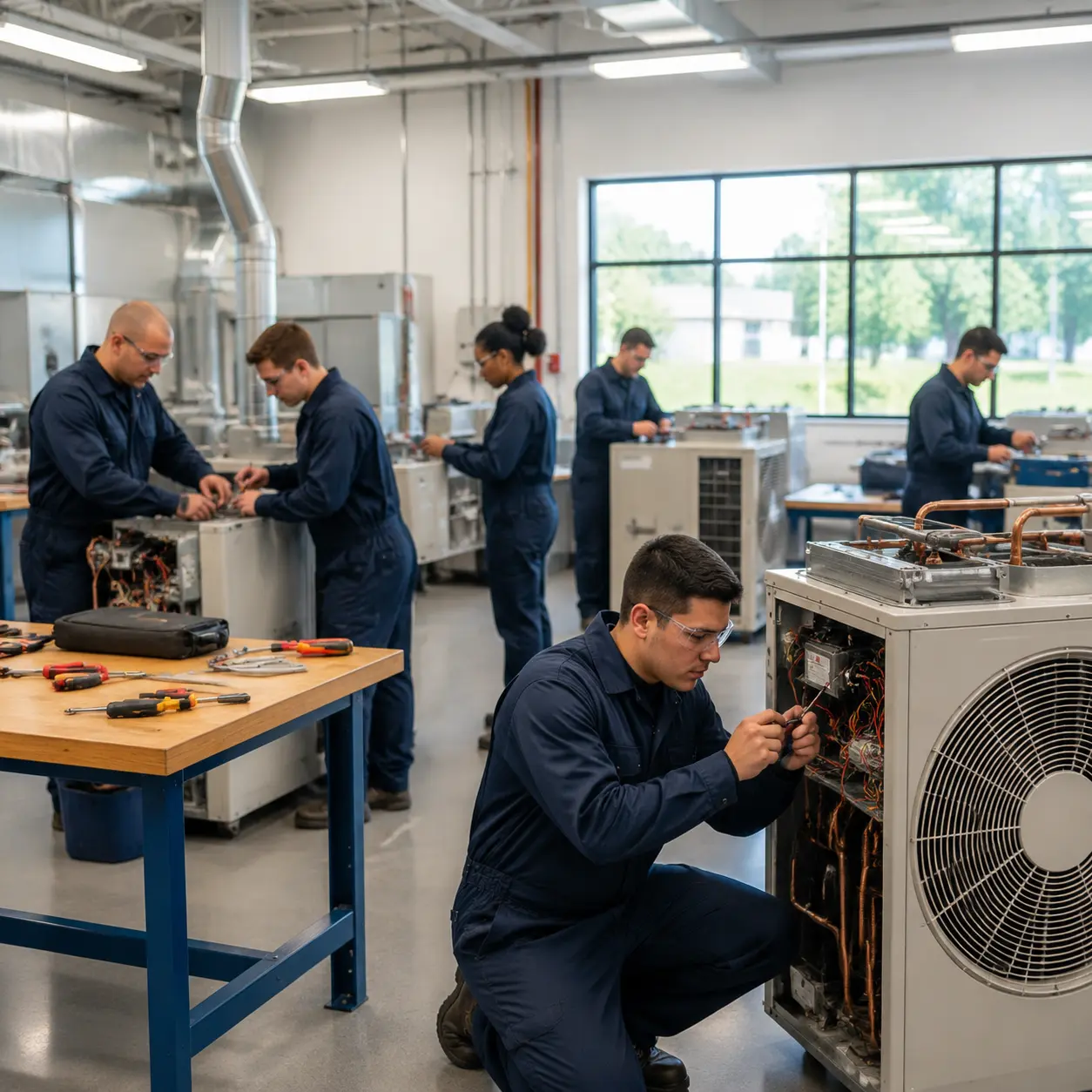
That heavy lab component matters. HVAC-R is a hands-on trade, and a program that pairs every hour of theory with an equal hour of practice tends to build more real-world confidence than a lecture-only course of the same length. Students who complete the program requirements receive a Certificate of Completion, though it is worth noting this certificate is not the same as a state license or EPA certification. Those are separate steps, covered next.
If you are still deciding whether the day or evening schedule fits your situation, scheduling a tour is a straightforward way to see the lab space and ask admissions about current start dates.
How Does EPA 608 Certification Fit Into Your Timeline?
This is a detail a lot of general HVAC guides skip past, but it genuinely affects your timeline.
The EPA requires nearly all HVAC technicians to hold Section 608 certification before they can legally handle refrigerant. The good news is that this certification is usually built into a postsecondary HVAC-R program rather than tacked on afterward. The exam itself does not take long to prepare for once you understand refrigeration fundamentals, since it is typically included as part of completing your training.
What can add time is confirming any additional state or local requirements. In Texas, for example, HVAC-R work is also connected to Texas Department of Licensing and Regulation (TDLR) registration, and requirements can vary depending on the type of work you plan to do. MT Training Center’s step-by-step guide to becoming an HVAC technician in Texas breaks down how EPA certification, TDLR requirements, and program training relate to one another, since these are related but separate credentials.
The practical takeaway: a completed training program gets you most of the way there, but plan on confirming current EPA and state requirements before you consider yourself fully credentialed.
What Can Make HVAC-R Training Take Longer or Shorter?
A published program length is a starting point, not a guarantee. A few things commonly shift the actual timeline:
- Day vs. evening schedule. Evening programs spread the same number of clock hours across more calendar weeks, which is why MT Training Center’s program runs 18 weeks during the day but 24 weeks in the evening. Evening classes can be easier to manage around a current job, but they take longer to finish.
- Attendance and pacing. Clock-hour programs generally require completing a set percentage of hours to graduate. Missed classes can extend your finish date.
- Prior experience. Someone who already has electrical or mechanical background may move through certain concepts faster, though lab requirements still apply to everyone.
- Specialization. Students who want to focus further on commercial refrigeration or building automation after finishing a general program may add time for additional coursework or on-the-job learning. MT Training Center’s comparison of residential vs. commercial HVAC careers is a useful read if you are trying to decide which direction fits your goals before you enroll.
None of these factors are reasons to worry. They are simply the variables that turn a general “6 months to 2 years” range into your specific timeline.
Is a Faster HVAC-R Program Worth It?
It is a fair question. Does a shorter program mean a weaker education?
Not necessarily, but it is worth understanding what you are trading. A well-structured program, like one built around equal lecture and lab hours, can move efficiently without skipping the hands-on repetition that builds real competence. What actually determines whether training holds up on the job is the quality of instruction and the amount of practical lab time, not simply how many months it took.
It also helps to understand why this decision matters right now. According to the Bureau of Labor Statistics, employment of heating, air conditioning, and refrigeration mechanics and installers is projected to grow 11 percent from 2025 to 2035, described by the BLS as much faster than the average for all occupations. The agency projects about 40,600 openings each year over that period, with many resulting from experienced technicians retiring or leaving the field. The median annual wage for the occupation was $61,010 as of May 2025.
That kind of demand means the real question is not “which program finishes fastest,” but “which program actually prepares me to do the work well.” A shorter timeline is only a win if you come out the other side able to diagnose a system, work safely around electricity and refrigerant, and handle the kind of problems you will see on a real job site.
Choosing the Right HVAC-R Training Timeline for You
Most people researching this question are really asking two things: how soon can I start working, and how much of a commitment am I signing up for. The honest answer is that both are flexible depending on the path you choose.
If you want to move quickly and prefer structured, hands-on classroom learning, a certificate program in the 6-month to 1-year range, like MT Training Center’s 18-week day or 24-week evening HVAC-R program, is likely your fastest route to entry-level readiness. If you would rather earn income while you learn and do not mind a longer road, an apprenticeship is worth exploring instead.
Whichever direction fits your situation, the next useful step is talking to someone who can walk you through current schedules, tuition, and start dates. MT Training Center’s admissions team can confirm details for the DeSoto, TX HVAC-R program, and financial assistance options are available for students who qualify. You can also apply directly once you are ready to take the next step.
Frequently Asked Questions
How long does it take to become an HVAC-R technician?
It depends on the path. A certificate program typically takes 6 months to a year, an associate degree takes about 2 years, and an apprenticeship generally takes 3 to 5 years. Most people also need to meet EPA and, in some states, additional licensing requirements before working independently.
What is the fastest way to complete HVAC-R training?
A full-time certificate program is generally the fastest structured option. MT Training Center’s HVAC-R program, for example, runs 600 clock hours over an 18-week day schedule, which is on the shorter end of the typical 6-month to 2-year range.
Is HVAC-R training faster than an apprenticeship?
Yes, in terms of classroom completion. A certificate program can be finished in months rather than years. However, an apprenticeship lets you earn wages throughout training, which is a different kind of value than speed alone.
Does EPA 608 certification add extra time to HVAC-R training?
Not usually. Most postsecondary HVAC-R programs build EPA 608 exam preparation into the curriculum, so it does not typically require a separate lengthy course. State or local licensing steps, where they apply, may require additional confirmation after training.
Can I complete HVAC-R training while working another job?
Many programs offer evening schedules for exactly this reason. MT Training Center offers a 24-week evening option for its HVAC-R program, covering the same 600 clock hours as the day program, just spread across more weeks.
Is a shorter HVAC-R program still good quality training?
It can be. What matters most is the balance of hands-on lab time to lecture time, not just the overall length. A program with equal lecture and lab hours, like MT Training Center’s HVAC-R curriculum, is built to develop real technical skill within its stated timeframe.
Program details, tuition, and requirements are subject to change. Contact MT Training Center’s admissions office to confirm current schedules, EPA and TDLR requirements, and start dates before enrolling.