If you are considering an HVAC career in Texas, figuring out where to start can be confusing. You may see terms like HVAC technician registration, TDLR certification, EPA Section 608 certification, apprenticeship, and contractor licensing. These credentials are related, but they are not the same thing.
For most beginners, becoming an HVAC technician in Texas involves learning practical HVAC-R skills, obtaining the appropriate Texas technician registration when required, working under a licensed Air Conditioning and Refrigeration contractor, and earning EPA Section 608 certification if the job involves regulated refrigerants.
You do not need a four-year degree to start preparing for this career. The U.S. Bureau of Labor Statistics reports that HVAC technicians typically enter the occupation with a postsecondary nondegree award, although some enter with less formal education and develop their skills through substantial on-the-job training.
This guide explains the Texas HVAC technician requirements, training options, apprenticeship pathway, TDLR registration, EPA certification, career advancement, costs, earnings, and practical steps for getting started.
What Does an HVAC Technician Do?
HVAC stands for heating, ventilation, and air conditioning. HVAC-R also includes refrigeration.
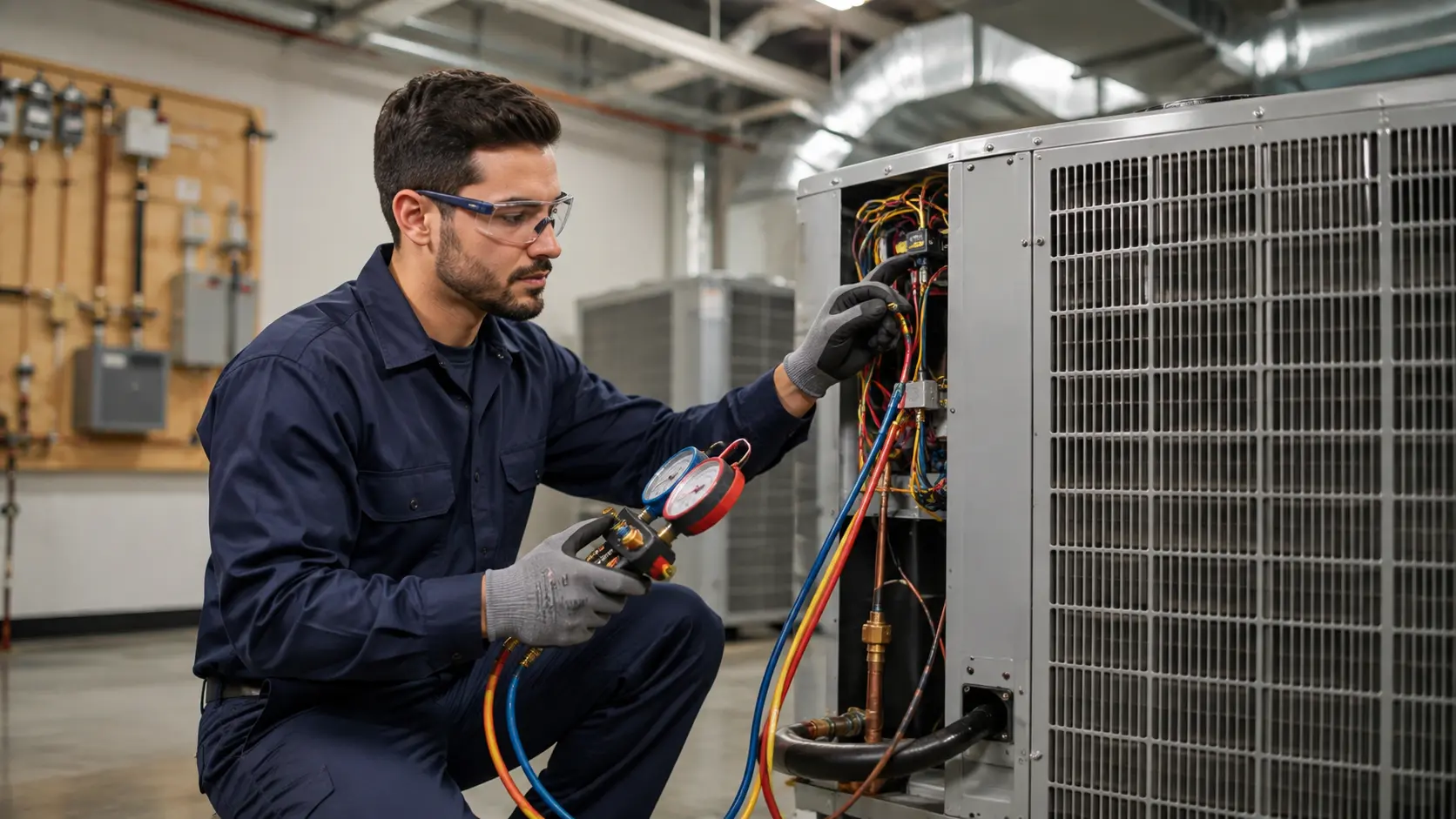
Technicians install, maintain, inspect, diagnose, and repair systems that control temperature and air quality in homes, businesses, schools, hospitals, and other buildings.
Common responsibilities include:
- Installing heating and cooling equipment
- Inspecting and testing HVAC systems
- Performing preventive maintenance
- Diagnosing electrical and mechanical problems
- Replacing damaged components
- Working with wiring and electrical controls
- Handling refrigerants when properly certified
- Explaining equipment problems to customers
The Bureau of Labor Statistics also identifies installation, electrical work, system testing, troubleshooting, repairs, and customer communication among common HVAC technician duties.
Because the occupation combines mechanical, electrical, diagnostic, and customer-service skills, practical training is an important part of career preparation.
Do You Need an HVAC License to Work in Texas?
You do not need to hold a Texas ACR contractor license simply to begin working as an HVAC technician, but Texas regulates technician work.
The Texas Department of Licensing and Regulation, commonly called TDLR, requires people who assist licensed Air Conditioning and Refrigeration contractors with covered maintenance or repair work to obtain either registered or certified technician status unless an exemption applies. Technicians work under the supervision of a licensed contractor and cannot independently advertise air conditioning and refrigeration services.
For a new Registered Technician application, TDLR currently requires applicants to be at least 16 years old. The registration fee is $20, and the registration is valid for one year.
Important: Texas requirements, fees, and regulations can change. Always verify the current rules directly with TDLR before applying or performing regulated work.
Step 1: Learn HVAC Fundamentals
Registration allows someone to work in the appropriate role, but it does not replace technical training.
A beginner needs to develop knowledge in areas such as:
- Refrigeration principles
- Electrical circuits
- Motors and controls
- Heating systems
- Airflow
- Safety procedures
- System diagnostics
- Troubleshooting
- Proper tool use
One option is structured vocational training. MT Training Center’s Advanced HVAC-R training program in DeSoto includes classroom and lab instruction in refrigeration, electrical circuits and controls, heating, safety, and diagnostic fundamentals. The program is currently listed at 600 clock hours, with an 18-week day schedule or 24-week evening schedule.
Students who want to understand the curriculum in more detail can also review what you learn in an HVAC technician certificate program.
HVAC School vs. Apprenticeship: Which Path Is Better?
There is no single training pathway that fits everyone.
HVAC school
A vocational HVAC program may be a good option for someone who wants structured instruction before entering or advancing in the workplace.
Training can help students build foundational knowledge in refrigeration, electrical systems, heating, diagnostics, safety, and equipment operation.
Apprenticeship or on-the-job training
Other beginners develop their skills while working.
A formal Registered Apprenticeship, when available, combines paid work experience, mentorship, classroom instruction, progressive wage increases, and a nationally recognized credential.
The federal Apprenticeship.gov finder can also be used to search available apprenticeship opportunities by occupation and location.
Which should you choose?
Consider HVAC school if you prefer structured instruction and hands-on practice before or while entering the trade.
Consider an apprenticeship or employer-based pathway if you have access to an employer willing to train you while you work.
Some people ultimately use both. They build technical fundamentals through vocational education and continue developing their skills through supervised field experience.
Step 2: Register With TDLR When Required
If your role involves assisting a licensed contractor with regulated air conditioning and refrigeration maintenance or repair work, review the TDLR technician registration requirements.
A Registered Technician generally:
- Works under a licensed ACR contractor
- Cannot independently advertise HVAC services
- Maintains a current technician registration
- Follows applicable Texas HVAC regulations
TDLR currently charges $20 for a new technician registration and requires applicants to be at least 16.
There are exemptions for certain people, work, and equipment, so check the current TDLR rules for your specific situation.
Step 3: Earn EPA Section 608 Certification When Required
Texas technician registration and EPA certification are different credentials.
EPA Section 608 certification is federally required for technicians performing covered service, maintenance, repair, or disposal work that could release regulated refrigerants.
Technicians must pass an EPA-approved examination administered through an approved certifying organization. EPA states that Section 608 certification does not expire.
There are four certification categories:
- Type I: Small appliances
- Type II: High-pressure appliances
- Type III: Low-pressure appliances
- Universal: Covers Type I, II, and III after the required examinations are passed
EPA identifies separate Core, Type I, Type II, and Type III examination content.
Students considering MT Training Center should confirm current EPA Section 608 preparation, testing, and certification arrangements directly with the school before enrollment. MT Training Center’s current program FAQ recommends verifying those details.
Step 4: Gain Supervised HVAC Experience
Classroom and lab training build a foundation. Field experience helps turn that knowledge into practical ability.
Entry-level technicians may assist with:
- Preventive maintenance
- Equipment installation
- System inspections
- Electrical testing
- Component replacement
- Basic diagnostics
- Cleaning and servicing equipment
BLS notes that HVAC technicians typically continue through a lengthy period of on-the-job training after they are hired.
This is also where technicians develop skills that cannot be learned from a textbook alone, such as troubleshooting under real conditions, communicating with customers, managing service calls, and working safely around active equipment.
Registered Technician vs. Certified Technician vs. HVAC Contractor
Understanding these credentials is one of the most important parts of becoming an HVAC technician in Texas.
| Credential | What It Means |
| Registered Technician | Texas designation that allows a technician to perform covered work under a licensed ACR contractor |
| Certified Technician | Voluntary higher-level TDLR designation requiring additional experience or approved training and an examination |
| ACR Contractor License | Separate Texas license for qualified professionals who meet contractor experience, examination, and other requirements |
| EPA Section 608 | Federal certification covering regulated refrigerant work |
TDLR specifically describes Certified Technician status as a voluntary qualification above Registered Technician status.
To qualify for Certified Technician status, an applicant must be at least 18 and meet one of two pathways:
Experience pathway: 24 months of HVAC-related work under a licensed contractor.
Approved training pathway: completion of a TDLR-approved program containing at least 2,000 hours of combined instruction and practical experience.
Applicants must then complete the TDLR examination process.
This is important for MT Training Center students to understand. MT Training Center’s 600-hour Certificate of Completion is not itself a Texas license, TDLR technician registration, EPA certification, or employer credential.
The program provides HVAC-R education and practical skill development, while state and federal credentials have their own requirements.
Can You Eventually Become a Licensed HVAC Contractor?
Yes. Contractor licensing can be a later career goal.
TDLR currently requires most contractor applicants to meet one of these experience pathways:
- At least 48 months of qualifying practical HVAC experience during the previous 72 months, or
- Certified Technician status for the previous 12 months plus at least 36 months of qualifying experience during the previous 48 months.
Contractor applicants must also meet examination, insurance, and other TDLR requirements. Certain experience exceptions may apply.
For someone new to HVAC, contractor licensing is typically a long-term advancement option rather than the first step.
How Long Does It Take to Become an HVAC Technician in Texas?
The answer depends on what you mean by “become an HVAC technician.”
Basic TDLR technician registration does not require several years of prior experience. Someone can begin learning the trade through school, an entry-level job, or another supervised training pathway.
Structured HVAC school may take several months. MT Training Center’s current program takes approximately 18 weeks during the day or 24 weeks in the evening.
Becoming a TDLR Certified Technician takes longer because the designation requires qualifying experience or an approved 2,000-hour training route plus an examination.
Contractor licensing requires substantially more qualifying experience.
What Is the Fastest Way to Start Working in HVAC in Texas?
For many beginners, the shortest practical pathway is:
Learn basic HVAC skills → find supervised entry-level employment → obtain TDLR technician registration when required → earn EPA Section 608 certification for applicable refrigerant work → continue building field experience.
The goal should not simply be to enter the field quickly. Employers also need technicians who understand safety, electrical systems, refrigeration principles, troubleshooting, and proper service procedures.
Structured training can help build that foundation before or alongside employment.
How Much Does It Cost to Become an HVAC Technician?
There is no single statewide cost.
Possible expenses include:
- Trade school tuition
- Registration fees
- Tools
- Safety equipment
- Books and training materials
- EPA testing
- Transportation
- Optional certifications
The TDLR Registered Technician application itself currently costs $20.
Students considering school should review total program costs and ask what is included. MT Training Center also provides financial aid information covering FAFSA, Pell Grants, student loans, VA benefits, and other resources, subject to individual eligibility.
How Much Do HVAC Technicians Make in Texas?
Actual earnings depend on experience, specialization, location, certifications, employer, and work schedule.
Texas Career Check currently lists annual wages of about $57,755 for heating, air conditioning, and refrigeration mechanics and installers in Texas and projects employment in the occupation to increase by approximately 13%.
Nationally, BLS reported a median annual wage of $59,810 in May 2024 and projects HVAC employment to grow 8% from 2024 to 2034, with about 40,100 openings per year on average.
These figures describe the occupation broadly and should not be treated as guaranteed starting salaries.
What Skills Do HVAC Employers Look For?
Technical knowledge matters, but employers also look for people who can work safely and reliably.
Useful skills include:
- Refrigeration fundamentals
- Electrical troubleshooting
- Heating-system knowledge
- Diagnostic ability
- Attention to safety
- Mechanical aptitude
- Communication
- Customer service
- Time management
- Willingness to continue learning
Modern HVAC systems continue to become more sophisticated, so technicians should expect to keep developing their technical knowledge throughout their careers.
Choosing an HVAC Training Program in Texas
Before enrolling in an HVAC program, ask:
- Does it include hands-on lab training?
- What refrigeration and electrical topics are covered?
- How long is the program?
- What credential will I receive?
- Is the school certificate separate from TDLR and EPA credentials?
- What are the full tuition and fee costs?
- Is financial assistance available to eligible students?
- Does the schedule work with my responsibilities?
MT Training Center offers its HVAC-R program in DeSoto, Texas, serving students in the Dallas-Fort Worth area. The 600-hour program combines classroom and laboratory training designed to develop practical entry-level skills.
Students can review the program details, speak with admissions, and schedule a campus tour before deciding whether the program fits their career plans.
Your Next Steps Toward an HVAC Career
There is no single certificate that completes the entire HVAC career journey.
For many people, the pathway looks like this:
Build HVAC knowledge → get practical training → register with TDLR when required → obtain EPA Section 608 certification for applicable work → gain supervised field experience → pursue advanced credentials as your career develops.
If you prefer structured, hands-on preparation, MT Training Center’s Advanced HVAC-R program provides a starting point for learning refrigeration, heating, electrical controls, safety, and system diagnostics.
The best next step is to compare your training options, understand the credentials required for the work you want to perform, and choose a pathway that gives you both practical skills and room to grow.
Frequently Asked Questions
How do I become an HVAC technician in Texas?
Learn HVAC fundamentals through vocational education, supervised employment, or another training pathway. If you perform covered work under a licensed ACR contractor, obtain the appropriate TDLR technician designation. EPA Section 608 certification is also required for applicable refrigerant work.
Do HVAC technicians need a license in Texas?
Technicians generally do not need an ACR contractor license to work under a licensed contractor, but covered technician work requires Registered or Certified Technician status unless an exemption applies.
How old do you have to be to register as an HVAC technician in Texas?
TDLR currently requires applicants for Registered Technician status to be at least 16 years old. Certified Technician applicants must be at least 18.
Do you need HVAC school to work in Texas?
Texas does not require everyone to complete a particular trade-school program before obtaining basic technician registration. However, vocational training can help beginners build refrigeration, electrical, heating, safety, and diagnostic skills before or while entering the workforce.
Is HVAC school better than an apprenticeship?
Neither route is automatically better. HVAC school provides structured technical instruction and lab practice, while an apprenticeship can combine paid employment with supervised learning. The best choice depends on your experience, learning style, finances, and access to employers or apprenticeship programs.
Do HVAC technicians need EPA 608 certification?
EPA Section 608 certification is required for technicians who perform covered work that could release regulated refrigerants. The credential requires passing an EPA-approved examination.
What is the difference between a registered and certified HVAC technician in Texas?
Registered Technician is the basic TDLR designation for covered technician work under a licensed contractor. Certified Technician is a voluntary higher-level designation requiring qualifying experience or approved training plus an examination.
Can I become an HVAC technician with no experience?
Yes. Beginners can start by learning HVAC fundamentals through vocational training or entry-level supervised employment. BLS notes that technicians typically continue developing competency through substantial on-the-job training after entering the occupation.
What is the fastest way to start an HVAC career in Texas?
A practical entry-level route is to learn basic HVAC skills, find supervised work with a licensed contractor, obtain TDLR technician registration when required, and earn EPA Section 608 certification if your work involves regulated refrigerants. Continue building hands-on experience after entering the field.
How long is HVAC training at MT Training Center?
MT Training Center currently lists its Advanced HVAC-R program at 600 clock hours, with an 18-week day schedule or 24-week evening schedule. Students should confirm current schedules, tuition, financial aid eligibility, and certification arrangements with the school before enrolling.