Choosing between a barber license and a cosmetology license can be confusing because the two careers share several skills but lead to different types of training and professional work.
The right choice depends on the services you want to offer, the environment you want to work in and your long-term career goals. This guide compares both licensing paths, including their training, permitted services and career opportunities, to help you decide which one fits you better.
The Core Difference Students Need to Understand
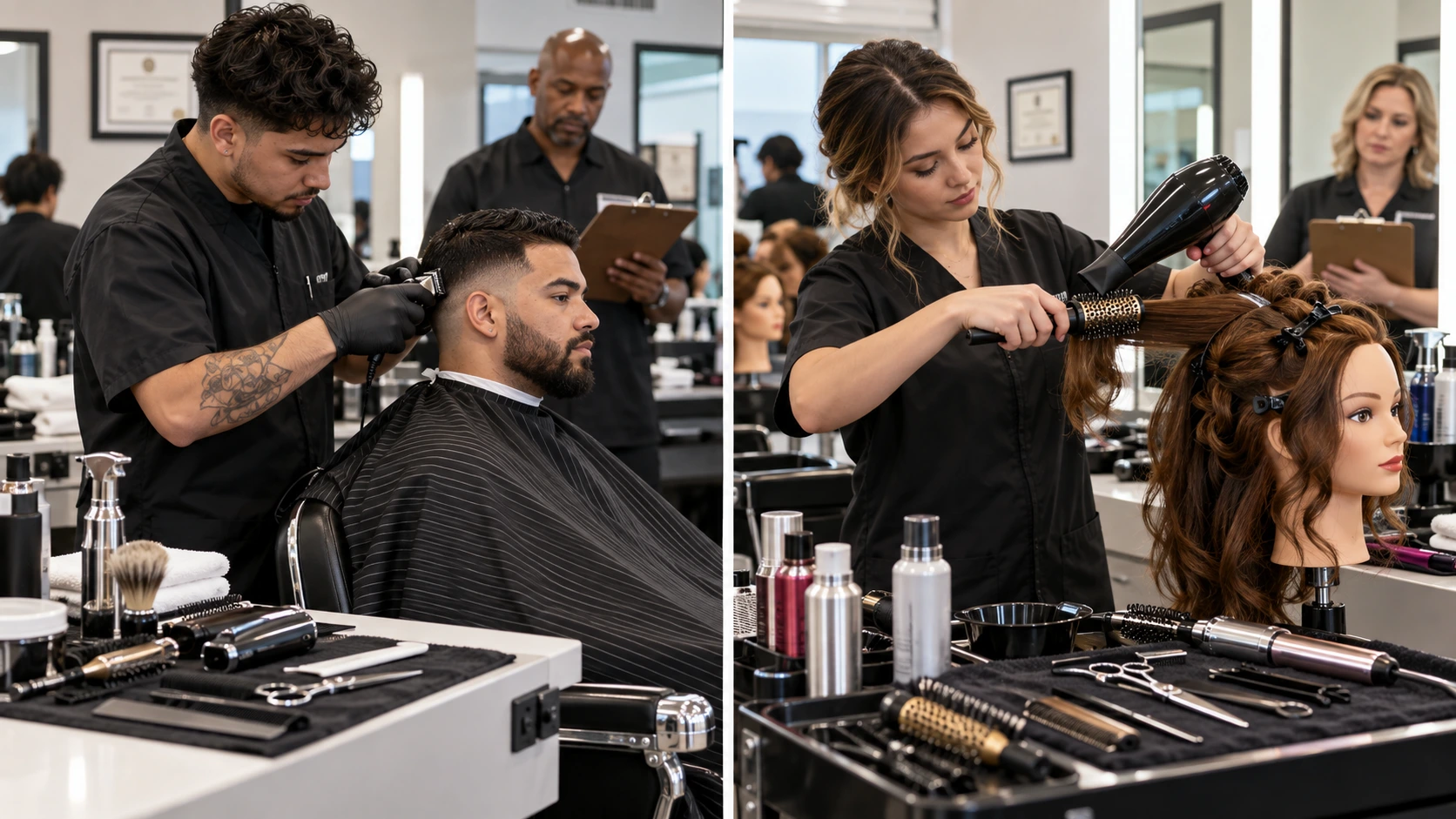
The biggest difference is scope of practice and training emphasis. Barber training places greater practical emphasis on haircutting, clipper work, grooming, beard services and shaving, while cosmetology training covers hair along with broader beauty services involving skin and nails.
In Texas, the distinction is narrower than many students expect. Cosmetology Operators can perform most barbering services except straight-razor shaving, while a Class A Barber can perform most cosmetology services except eyelash-extension services.
A Barber License Focuses More Heavily on Barbering and Grooming
Students interested in fades, tapers, beard work, shaving and barbershop services usually benefit from training built around those skills.
MT Training Center’s Class A Barber curriculum includes haircutting, styling, shaving, beard care, sanitation, barber law, client service and business skills.
A Cosmetology License Provides Broader Beauty Training
Cosmetology is generally the stronger fit for students who want exposure to haircutting, coloring, chemical texture, skin care, nail care and salon services.
MT Training Center’s Cosmetology Operator program includes hair, skin, nails, sanitation, salon safety, business skills and licensing-exam preparation.
Barber License vs Cosmetology License Comparison Table
| Factor | Class A Barber | Cosmetology Operator |
| Haircutting | Yes | Yes |
| Fades & clipper work | Yes | Yes |
| Beard services | Yes | Generally permitted |
| Straight-razor shaving | Yes | No in Texas |
| Hair coloring | Yes within scope | Yes |
| Chemical hair services | Yes within scope | Yes |
| Skin services | Broad overlap | Yes |
| Nail services | Broad overlap | Yes |
| Eyelash extensions | No under Class A scope | Operator scope differs; specialist rules apply |
| MT Training hours | 1,000 hours | 1,000 hours |
| Best fit | Barber-focused careers | Broader salon/beauty careers |
The table highlights an important point: choosing a license based only on “men’s hair versus women’s hair” is outdated. The better question is which services you want to build your career around.
What Services Can You Perform With a Barber License?
A Texas Class A Barber license supports a broad range of professional barbering and personal-care services, with straight-razor shaving being one of its clearest distinctions from cosmetology.
Haircuts, Fades, Tapers and Clipper-Based Services
Barber training develops precision in haircutting, blending, clipper control, styling and grooming. These skills are especially important in barbershop environments where repeat clients often request highly specific cuts.
Beard Grooming and Straight-Razor Shaving
Beard shaping, grooming and shaving are central barbering skills. In Texas, straight-razor shaving is not included in the Cosmetology Operator scope, making this a major consideration for students planning traditional barber services.
What Services Can You Perform With a Cosmetology License?
A Cosmetology Operator license is designed for students who want a broader service mix rather than a barber-focused specialization.
Haircutting, Styling, Coloring and Chemical Services
Cosmetology training commonly combines haircutting with hair color, bleaching, perms, relaxers, styling and hair-care theory.
Skin and Nail Services
Cosmetology education also includes skin-care and nail-care competencies. MT Training Center’s 1,000-hour program specifically includes hair care, nail care, skin care, sanitation and exam review.
Which License Do You Need for the Services You Want to Offer?
Choose your license by working backward from the services you want clients to book. If your ideal workday is dominated by fades, clipper cuts, beard detailing and straight-razor services, barber training is the more focused path. If you want haircutting combined with color, chemical texture, skin, nails and broader salon services, cosmetology usually provides the more relevant training base.
Barber License vs Cosmetology License Service-by-Service Decision Matrix
| Career Goal | Better Training Fit |
| Fades and clipper cuts | Barber |
| Beard grooming | Barber |
| Straight-razor shaving | Barber |
| Hair coloring | Cosmetology or Barber within permitted scope |
| Perms and relaxers | Cosmetology-heavy training |
| Nail services | Cosmetology |
| Skin-care services | Cosmetology-heavy training |
| Broad salon career | Cosmetology |
| Traditional barbershop career | Barber |
Think of this as a career decision matrix, not a legal substitute for state rules. Scope can change, so students should verify any specific service with the appropriate licensing authority before practicing professionally.
Barber School and Cosmetology School Have Different Training Priorities
At MT Training Center, both programs are listed at 1,000 clock hours, but those hours are not spent developing identical competencies. The barber program emphasizes haircutting, shaving, beard care, sanitation and barber laws, while cosmetology distributes training across hair, skin, nails, safety and salon services.
That difference matters because two students can spend the same number of hours in school and graduate with different practical strengths.
Barber and Cosmetology Licensing Exams Test Professional Competency
Completing school is only part of the licensing path. Students must also satisfy applicable Texas Department of Licensing and Regulation requirements, including the examination process required for their license type.
Both training paths therefore require more than technical creativity. Sanitation, infection control, safety, state rules and professional standards are core competencies.
Barber and Cosmetology Licenses Lead to Different Career Paths
A barber graduate may naturally pursue barbershops, grooming studios, independent barbering, or eventually barbershop ownership. A cosmetology graduate may pursue salons, hairstyling, color-focused work, broader beauty services, or future salon ownership.
Career changers who discover that beauty is not their preferred trade can also compare MT Training Center’s Combination Welding, CNC Machinist, Computerized Accounting, Advanced Electrical Lineworker and HVAC-R career-training paths.
Barber License vs Cosmetology License: Which One Is Better for Your Career Goals?
Neither license is automatically better. The stronger option is the one whose training and legal scope align with the services you want clients to pay you for.
Choose barbering when barber-specific grooming and shaving are central to your plan. Choose cosmetology when you want broader exposure across hair and beauty services.
Can a Barber Become a Cosmetologist or a Cosmetologist Become a Barber?
Yes, professionals can pursue additional licensing, but the required education, examinations and credit for previous training depend on current state rules.
Do not assume that holding one license automatically grants the other. Verify current crossover requirements before enrolling in additional training.
Can You Hold Both a Barber License and a Cosmetology License?
Where state rules permit it, professionals may qualify for more than one credential. Doing so can make sense when a career genuinely requires services that fall across different licensing boundaries.
The decision should be based on service scope and business goals, not simply collecting credentials.
Barber and Cosmetology License Rules Are Different in Every State
Training hours, examinations, license names, reciprocity and permitted services can differ significantly by state. Students planning to work in Texas should use current TDLR requirements rather than relying on licensing information written for another state.
This is particularly important for restricted services such as straight-razor shaving and specialty beauty services.
Key Takeaways Before Choosing Between a Barber and Cosmetology License
- Barbering and cosmetology overlap, but they are not identical licenses.
- Class A Barber training is more focused on barbering, shaving, grooming and precision haircutting.
- Cosmetology training provides broader exposure to hair, skin, nail and salon services.
- In Texas, Cosmetology Operators cannot perform straight-razor shaving.
- Both MT Training Center programs currently list 1,000 clock hours.
- Choose based on the services you want to provide professionally.
- Always verify current scope-of-practice rules before offering a regulated service.
Frequently Asked Questions
Is a Barber License the Same as a Cosmetology License?
No. They are separate licenses with different training priorities and service permissions.
Barbering is more focused on haircutting, fades, beard grooming, and shaving, while cosmetology generally covers a broader mix of hair, color, chemical services, skin care, and nail care.
Can I Be a Barber With a Cosmetology License in Texas?
A Texas Cosmetology Operator can perform many services commonly offered in barbershops, including haircutting, styling, beard trimming, and shaving with a safety razor.
However, cosmetologists cannot perform straight-razor shaving. If you want the full Class A Barber scope, Texas offers a crossover pathway for licensed cosmetologists.
Can Barbers Color Hair in Texas?
Yes. A Texas Class A Barber can perform hair coloring and many other services that overlap with cosmetology.
This means barbering is not limited to fades and beard work. Students interested in both precision cutting and chemical hair services can build those skills within the barbering scope.
What Is the Difference Between a Beauty Salon and a Barber Shop?
A barbershop usually focuses on haircuts, fades, beard grooming, shaving, and shorter styles.
A beauty salon typically offers a broader service mix, including haircutting, styling, coloring, chemical treatments, skin care, and nail services. What a professional can legally perform depends on their license, not simply the type of business they work in.
What Is Cosmetology?
Cosmetology is professional training in hair, skin, and nail services.
Students may learn haircutting, styling, hair color, chemical treatments, sanitation, skin care, nail care, and salon procedures. It is generally a better fit for students who want a broader beauty-service career rather than a barber-focused path.
Which License Takes Longer to Get?
In Texas, both the Class A Barber and Cosmetology Operator training paths can require 1,000 hours of instruction, depending on the approved program.
At MT Training Center, both the Class A Barber program and Cosmetology Operator program list 1,000 clock hours.
Which License Gives You More Career Options?
Cosmetology generally gives students broader exposure to hair, skin, nails, coloring, and salon services.
Barbering is more specialized, but that specialization can be valuable for students who want to build a career around precision cuts, fades, beard services, and traditional barbering. The better choice depends on the services you actually want clients to book.
What Is the Highest-Paid Cosmetology Job?
There is no single highest-paid cosmetology job because earnings depend heavily on specialization, location, clientele, pricing, and whether you own a business.
Experienced salon owners, specialty colorists, high-end hairstylists, educators, and independent professionals often have stronger earning potential because they can charge premium rates or earn from multiple revenue streams.
Can You Get Both a Barber and Cosmetology License?
Yes. Professionals can hold both licenses if they meet their state’s education and examination requirements.
In Texas, crossover pathways can reduce the amount of additional training required for someone who already holds one of the licenses.
Can a Cosmetologist Use a Straight Razor in Texas?
No. A Texas Cosmetology Operator cannot perform straight-razor shaving for compensation.
This is one of the clearest practical differences between the two license types and can be an important deciding factor for students who want to offer traditional shaving services.