Barber School vs Cosmetology School in Texas: Career Guide
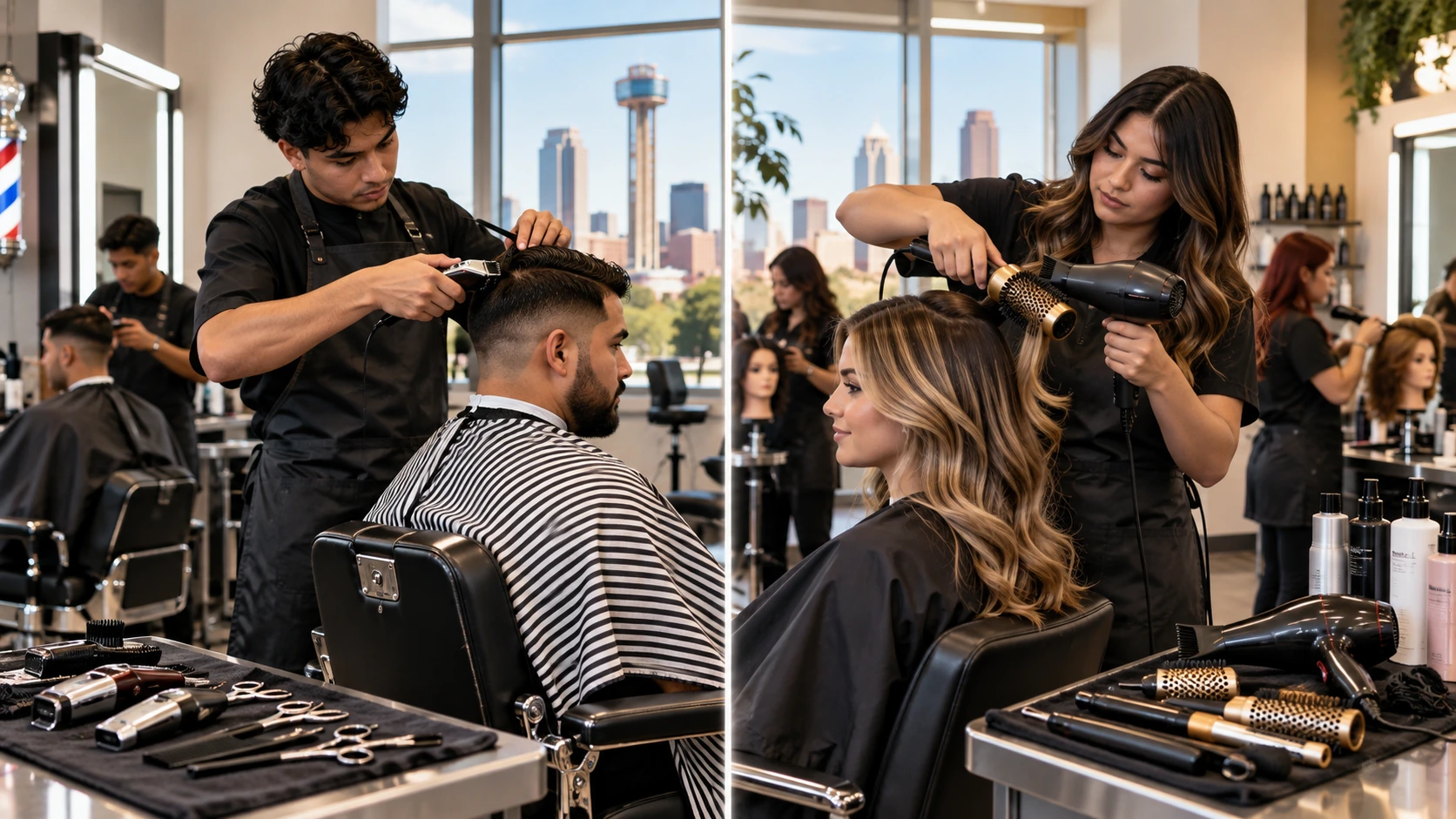
Choosing between barber school and cosmetology school in Texas comes down less to training length and more to the work you want to perform after licensing. Both the Class A Barber and Cosmetology Operator paths require 1,000 hours of approved instruction, followed by written and practical licensing exams.
The bigger question is what you want your daily career to look like. Barber training places emphasis on shaving, beard work, and men’s haircutting, while cosmetology adds specialty training in areas such as advanced chemical services and eyelash extensions.
Barber School vs Cosmetology School in Texas: What Is the Main Difference?
Texas gives these licenses substantial overlap. A Class A Barber can perform most cosmetology services except eyelash extensions, while a Cosmetology Operator can perform most barbering services except straight-razor shaving.
What Texas Barber School Prepares You to Do
Barber training is especially relevant if you want to develop expertise in men’s haircutting, razor techniques, shaving, mustache care, and beard services. This makes it a natural fit for someone who sees themselves building a clientele around barber-focused grooming.
What Texas Cosmetology School Prepares You to Do
Cosmetology training emphasizes advanced hair care, chemical services, and related salon practices, while also covering many services that overlap with barbering. The distinction matters most when your intended service mix includes areas unique to cosmetology licensing.
Why Career Fit Matters More Than Program Length
Both primary programs require 1,000 hours, so choosing cosmetology does not automatically mean longer schooling than barbering. Your decision should therefore begin with services and career direction rather than assumptions about which program is quicker.
Summarized Comparison Table: Barber School vs Cosmetology School in Texas
| Factor | Class A Barber | Cosmetology Operator |
| Required training | 1,000 hours | 1,000 hours |
| Licensing exams | Written + practical | Written + practical |
| Distinctive training | Shaving, razors, beard care, men’s cuts | Advanced chemical/hair services, eyelash extensions |
| Common setting | Barbershop, suite, independent | Salon, suite, independent |
| Major scope exception | Eyelash extensions | Straight-razor shaving |
| Crossover option | 300-hour cosmetology pathway | 300-hour barber pathway |
The table highlights why Texas students should look beyond broad stereotypes. The actual decision becomes clearer once you examine what each program teaches in greater depth.
Texas Barber and Cosmetology Licensing Requirements
Class A Barber License Requirements in Texas
A prospective Class A Barber must complete a 1,000-hour course at a Texas-licensed barbering/cosmetology school. Applicants must also pass written and practical examinations.
Cosmetology Operator License Requirements in Texas
A Cosmetology Operator follows the same basic structure: 1,000 hours of approved instruction plus written and practical licensing exams. This makes curriculum focus more useful for comparison than total required hours.
Why TDLR Requirements Matter When Choosing a School
Verify that the program follows curriculum requirements established by the Texas Department of Licensing and Regulation (TDLR). A school may offer training beyond the required curriculum, so compare what those additional hours actually add before paying for them.
What You Learn in Barber School in Texas
Texas barber curriculum specifically includes specialty practice involving razor techniques, shaving, mustache and beard care, advanced hair care, and men’s haircutting. These skills matter if your ideal workday revolves around precision grooming and barber-focused clientele.
You will also develop professional practices related to sanitation, client care, tools, safety, and service delivery. That technical emphasis leads directly to the strongest reason for choosing barbering: the type of services you want to perform repeatedly.
What You Learn in Cosmetology School in Texas
Cosmetology training shares considerable foundational material with barbering but adds specialty instruction around advanced hair care, advanced chemical services, and eyelash-extension practices.
For someone who imagines a salon-centered career involving varied hair transformations and a wider mix of cosmetology-specific services, that specialty training may align better. The deciding factor should still be the services you genuinely want to build expertise around.
Barber School vs Cosmetology School: Which Services Do You Want to Perform?
Choose barber training when straight-razor shaving, beard work, and barber-focused cutting are central to your career plan. Choose cosmetology when its specialty services, particularly chemical hair services and eyelash extensions, align more closely with your intended work.
Do not assume the two professions operate in completely separate service worlds. Texas intentionally recognizes significant overlap between the licenses, making specialization more important than simplistic “barber versus hairstylist” labels.
The Career Fit Framework: Choose Based on the Workday You Want
Evaluate each option through five practical questions:
- Services: What services would you enjoy performing repeatedly?
- Clients: What type of clientele do you want to build?
- Environment: Do you picture yourself primarily in a barbershop, salon, or independent suite?
- Business model: Do you eventually want employment, chair rental, independent work, or ownership?
- Flexibility: Might you want the second license later?
For example, someone excited by fades, beard design, and straight-razor work has a different ideal workday from someone focused on color transformations and cosmetology-specific services. Thinking in terms of that future workday makes the school decision much more practical.
Barber Career Paths After School in Texas
A barber can build experience inside an established shop, develop a repeat clientele, move toward independent work, or eventually pursue business ownership. The value of barber school increases when its practical training matches the services and customer experience you intend to build.
If your interests broaden later, Texas also provides a pathway toward adding cosmetology credentials. That flexibility means your first license does not necessarily lock you into one professional direction.
Cosmetology Career Paths After School in Texas
Cosmetology graduates may pursue salon employment, independent styling, suite-based work, specialization, or eventually their own business. Your school choice should support the specific services you want to become known for rather than simply offering the largest course list.
A cosmetologist interested in expanding into barber-specific work can also pursue additional barber training. This brings us to one of the most overlooked advantages of the Texas system.
Can You Become Both a Barber and Cosmetologist in Texas?
Yes. A licensed Class A Barber can pursue a Cosmetology Operator license through a 300-hour cosmetology crossover course, while an eligible licensed Cosmetology Operator can complete 300 hours of additional barber training toward a Class A Barber license.
For students still choosing their first path, MT Training Center offers both Class A Barber and Cosmetology Operator programs at its DeSoto campus, allowing prospective students to compare both career-training options before enrolling.
This flexibility means your first license does not have to define your entire career. You can begin with the path that best matches your current goals and expand your professional services later.
Barber School vs Cosmetology School: Which Has Better Career Flexibility?
Neither license is universally “better” for every student because Texas gives both broad and overlapping scopes of practice. Barbering preserves access to straight-razor services, while cosmetology includes eyelash-extension services that Class A Barbers cannot perform under that license alone.
The more useful question is which license covers the services you want to build your initial career around. Additional licensing can expand your professional options later.
How to Choose Between Barber School and Cosmetology School in Texas
Choose barber school if shaving, beard work, men’s haircutting, and barber culture are central to your career vision. Choose cosmetology school if advanced chemical hair services and cosmetology-specific salon services better match the clientele you want.
Then compare individual schools by curriculum, hands-on practice, licensing preparation, schedule, cost, and career support. The license determines what you can legally do, but the quality of your training influences how prepared you are to actually do it well.
Questions to Ask Before Enrolling
Before signing an enrollment agreement, ask:
- Is the school properly licensed in Texas?
- How much supervised hands-on practice is included?
- How does the program prepare students for licensing exams?
- What services receive the most practical training?
- What costs exist beyond advertised tuition?
- Does the curriculum fit the career I actually want?
These questions separate a convenient school from a program that genuinely supports your intended career.
Key Takeaways: Barber School vs Cosmetology School in Texas
- Both primary programs require 1,000 training hours.
- Both require written and practical exams.
- Barber training emphasizes razors, shaving, beard care, and men’s haircutting.
- Cosmetology adds specialty training in advanced chemical services and eyelash extensions.
- The licenses have substantial service overlap.
- Texas offers 300-hour crossover pathways for eligible existing license holders.
- Choose according to your intended services, clientele, and work environment.
Frequently Asked Questions
Is Barber School Easier Than Cosmetology School in Texas?
Not necessarily. Barber school and cosmetology school both require 1,000 instructional hours in Texas, so neither path is automatically easier. The main difference is the type of technical training and services students practice.
Barber programs place more emphasis on shaving, beard work, and barber-focused cutting, while cosmetology programs include broader salon and chemical-service training. The easier option usually depends on your interests and natural strengths.
How Long Is Barber or Cosmetology School in Texas?
Both Class A Barber and Cosmetology Operator programs require 1,000 instructional hours in Texas. The actual number of months you spend in school depends on whether you attend full-time or part-time and how the school schedules training.
A full-time student may finish much faster than someone attending evenings or limited weekly hours. Always ask the school for its estimated completion timeline before enrolling.
Can a Cosmetologist Work as a Barber in Texas?
Yes, a Texas Cosmetology Operator can perform many barbering services, including haircutting, beard and mustache services, and shaving with a safety razor. However, a cosmetology license does not authorize straight-razor shaving.
If straight-razor services are important to your career, you would need the appropriate barber license. Texas also offers a reduced crossover pathway for eligible licensed cosmetologists who want to become Class A Barbers.
Can a Barber Become a Cosmetologist?
Yes. An eligible Texas Class A Barber can become a Cosmetology Operator by completing the required 300-hour cosmetology crossover program, passing the required exams, and meeting TDLR licensing requirements.
This pathway gives barbers a practical way to expand their service options without completing another full 1,000-hour program. It can be especially useful for professionals who want to move into broader salon or cosmetology services later.
Which School Should I Choose?
Choose the school whose hands-on training best matches the services and career you want after graduation. Barber-focused students should prioritize strong cutting, shaving, and grooming practice, while cosmetology-focused students should look closely at salon, chemical, and advanced hair-service training.
Then compare practical training hours, licensing-exam preparation, total cost, schedule flexibility, instructor experience, facilities, and career support. The best school is the one that prepares you for the work you actually want to do.
Is It Better to Be a Barber or Cosmetologist?
Neither is universally better. Barbering may suit you more if you want to focus on fades, beard work, men’s grooming, and straight-razor shaving. Cosmetology may be a better fit if you prefer broader salon services, hair coloring, chemical treatments, and beauty-related services.
In Texas, both licenses cover many overlapping services, so your ideal clients, work environment, and long-term service mix should guide your choice.
Can I Be a Barber With a Cosmetology License in Texas?
Yes, a Texas Cosmetology Operator can perform many barbering services, including haircutting, beard and mustache services, and shaving with a safety razor. However, a cosmetology license does not allow straight-razor shaving, which requires barber licensing.
If you want a full Class A Barber license, Texas offers a 300-hour crossover pathway for eligible licensed cosmetologists.
How Can a Barber Make $100,000 a Year?
A barber can reach $100,000 in annual revenue by combining higher-value services, strong client retention, consistent bookings, and efficient scheduling. For example, an average $50 ticket across eight clients per day, five days per week, for 50 weeks equals about $100,000 in gross revenue.
Take-home income will be lower after expenses such as chair rent, supplies, taxes, insurance, and payment fees. Increasing average ticket value can make the goal more realistic.
How Much Does Barber School Cost in Texas?
Barber school in Texas can vary significantly by school, location, and what is included in the program. Many 1,000-hour Class A Barber programs fall roughly within the $10,000 to $18,000 range based on published tuition and fee examples from Texas schools.
Always compare the total program cost, not tuition alone. Ask whether books, barber kits, registration fees, uniforms, supplies, and additional training charges are included before enrolling.
Compare barber school vs cosmetology school in Texas, including training, licensing, services, career paths, and which option best fits your goals.