To become a diesel mechanic, individuals typically need a high school diploma or GED, practical mechanical skills and hands-on training. Beginners can enter the field through a diesel mechanic training program, trade school, apprenticeship or employer-sponsored training. A college degree or ASE certification is not generally required to start working.
Depending on the training pathway, some certificate programs take 6–12 months, while associate degree programs usually take about two years. Training focuses on diesel engine repair, preventive maintenance, electrical systems and computerized diagnostics.
A diesel mechanic career offers opportunities in trucking, transportation, fleet maintenance and heavy equipment repair. Career growth and earning potential depend on practical experience, technical specialization and professional certifications.
How to Become a Diesel Mechanic Step by Step
To become a diesel mechanic, individuals should follow a practical six-step process that connects education, technical training and workplace experience. These steps help beginners develop the qualifications employers expect.
- Step 1: Complete high school or earn a GED. Build basic mathematics, reading and mechanical reasoning skills.
- Step 2: Choose diesel mechanic training. Consider a trade school, community college or employer-sponsored apprenticeship program.
- Step 3: Learn essential repair skills. Study diesel engines, diagnostic procedures and vehicle systems.
- Step 4: Gain hands-on training. Practice under instructor or technician supervision.
- Step 5: Apply for entry-level positions. Seek trainee opportunities at repair facilities or transportation companies.
- Step 6: Pursue certifications. Build qualifying experience and prepare for relevant ASE examinations.
This process helps beginners progress from foundational knowledge to employable capabilities. Understanding the actual diesel mechanic requirements makes choosing the right pathway easier.
What Education Is Needed to Become a Diesel Mechanic?
Diesel mechanic education typically begins with a high school diploma or equivalent qualification. Employers may prefer applicants who have completed postsecondary diesel technology training, but an associate degree is not universally required.
Students benefit from mathematics, basic physics, electronics and automotive technology coursework. These subjects support mechanical measurements, electrical testing and interpretation of service information.
Can Someone Become a Diesel Mechanic Without a College Degree?
Yes. A person can become a diesel technician without a college degree by completing vocational training or learning through supervised employment. A technical school can provide structured preparation, while some employers accept beginners who demonstrate mechanical aptitude.
Is Diesel Mechanic School Necessary?
A diesel mechanic school is not mandatory for every entry-level opportunity. However, structured education can help students learn repair procedures, operate diagnostic equipment and practice safely before working independently.
What Are the Different Diesel Mechanic Training Pathways?
The main pathways include a diesel mechanic program at a vocational institution, a community college diesel technology program or a diesel mechanic apprenticeship. Each provides a different balance of classroom instruction, practical experience, time commitment and cost.
Trade School and Technical School Programs
A trade school or technical school typically emphasizes diesel engine repair, vehicle maintenance and shop-based instruction. A certificate program may combine diesel engine technology with electrical diagnosis and supervised repairs.
Community College Diesel Technology Programs
A community college may offer a certificate program or associate degree combining technical coursework with broader academic subjects. This pathway can suit students seeking a formal credential alongside career preparation.
Apprenticeships and On-the-Job Training
An apprenticeship allows beginners to develop technical skills while working alongside experienced technicians. On-the-job training may include maintenance inspections, component replacement and progressively more complex repairs.
Summarized Comparison Table: Diesel Mechanic Training Options
|
Training pathway |
Main advantage |
Key consideration |
|
Trade school |
Focused practical instruction |
Tuition and equipment costs |
|
Community college |
Technical and academic education |
Often a longer commitment |
|
Apprenticeship |
Earn while developing skills |
Availability varies by employer |
|
Employer training |
Workplace-specific experience |
May offer narrower initial exposure |
A recent graduate might prefer organized lessons, while a career changer may prioritize paid training. The best choice depends on the skills each route develops.
What Skills Do Diesel Mechanics Need?
Diesel mechanics need mechanical skills, engine diagnostics, electrical knowledge and systematic troubleshooting abilities. They must inspect diesel engines, identify faults, perform preventive maintenance and verify repairs using appropriate tools.
Diesel Engine Repair and Maintenance
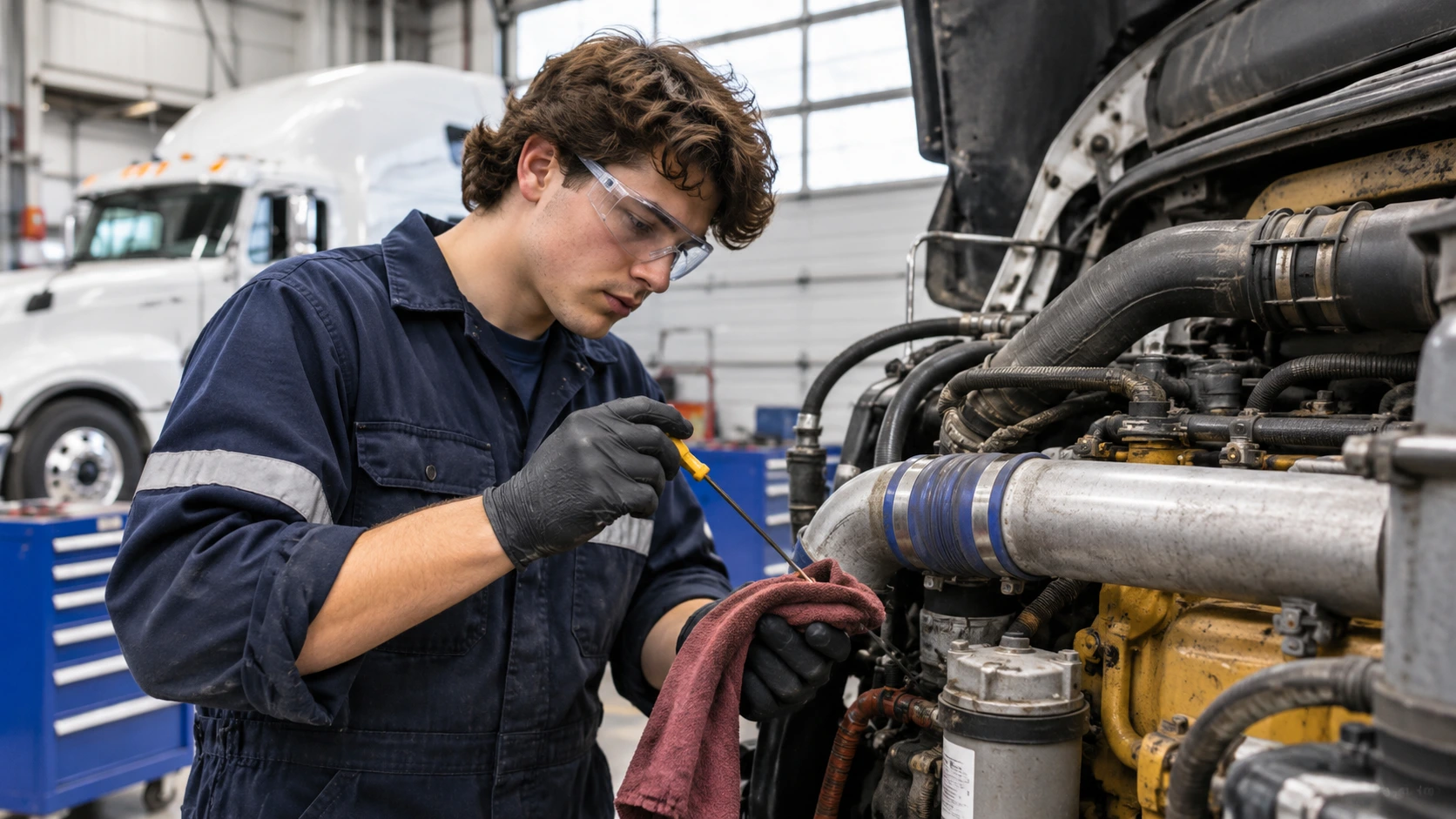
Diesel engine maintenance involves servicing engine components, checking fluid levels, inspecting cooling systems and following manufacturer maintenance schedules. Technicians also perform service inspections and evaluate engine performance.
Effective diesel engine troubleshooting requires identifying the cause of a problem before replacing parts.
Engine Diagnostics and Electrical Troubleshooting
Modern diesel technology relies heavily on computerized diagnostics. Technicians use diagnostic scan tools to retrieve fault codes, examine sensor readings and investigate the engine control module (ECM).
Electrical systems require knowledge of wiring, voltage testing and component operation. Accurate troubleshooting helps prevent unnecessary repairs.
Fuel, Hydraulic and Emissions Systems
Technicians work with fuel injection systems, hydraulic systems, brake systems and transmission systems. They also inspect exhaust systems and emissions control systems.
Important components include:
- Diesel particulate filter (DPF) for trapping exhaust particles.
- Selective catalytic reduction (SCR) for reducing nitrogen oxide emissions.
- Diesel exhaust fluid (DEF) used by SCR-equipped vehicles.
Workplace Safety and Technical Documentation
Safe technicians use hand tools and power tools correctly, follow workplace safety procedures and consult technical manuals. Accurate repair documentation helps maintain service histories and confirm completed work.
These skills form the foundation for performing repairs confidently in professional workshops.
What Does a Diesel Mechanic Do?
A diesel mechanic inspects, maintains, diagnoses and repairs diesel-powered vehicles and machinery. Daily responsibilities include preventive maintenance, computerized diagnostics, component replacement and testing completed repairs.
Work may involve heavy-duty trucks, buses and trucks in commercial fleets or specialized construction equipment. Some technicians also service agricultural equipment, depending on their employer and specialization.
How Long Does It Take to Become a Diesel Mechanic?
How long does it take to become a diesel mechanic? Some certificate programs can be completed in approximately 6–12 months, while associate degree programs commonly take about two years. Apprenticeship and workplace learning timelines vary considerably.
Training duration depends on program structure, attendance schedule and previous experience. Someone with automotive repair knowledge may progress faster through familiar concepts, although workplace proficiency still takes practice.
Completing a program does not automatically mean someone can independently diagnose every fault. Continued experience remains important after graduation.
How Much Does Diesel Mechanic School Cost?
The cost of diesel mechanic school varies by institution, program length and location. Students should compare tuition, registration charges, textbooks, safety equipment, tools and transportation before enrolling.
Financial aid, scholarships and eligible workforce funding may reduce expenses. Employer-sponsored training can provide an alternative for students unable to afford conventional tuition.
Comparing total educational expenses against practical instruction hours helps applicants judge value more effectively.
Do Diesel Mechanics Need ASE Certification?
Diesel mechanic certification is not universally required for initial employment. However, ASE certification can demonstrate verified industry knowledge and help qualified technicians strengthen their professional credentials.
The National Institute for Automotive Service Excellence, also known as Automotive Service Excellence, administers recognized certification examinations.
How to Become a Certified Diesel Mechanic
To understand how to become a certified diesel mechanic, applicants should identify the relevant ASE examination, prepare for its technical content, pass the test and satisfy applicable work experience requirements.
The ASE T2 Diesel Engines certification addresses medium- and heavy-duty diesel engine systems. It belongs to the ASE Medium-Heavy Truck Certification series.
Professional-level T-series certification generally requires two years of relevant repair experience, although approved education may substitute for part of that requirement.
Can Beginners Earn ASE Certification?
ASE Entry-Level Certification is available through participating educational programs and does not require prior professional experience. It differs from credentials earned by experienced technicians.
Becoming an ASE-certified technician at the professional level requires meeting the relevant examination and experience conditions.
Industry certifications, manufacturer-specific training and continuing education can support subsequent professional development.
How to Get an Entry-Level Diesel Mechanic Job
An entry-level diesel mechanic candidate can improve employment prospects by demonstrating practical skills, safety awareness and familiarity with common service procedures.
Potential employers include truck repair shops, automotive repair shops, trucking companies, fleet maintenance facilities and organizations operating commercial vehicles.
Applicants should highlight completed training, diagnostic projects, shop experience and their ability to follow technical instructions.
For example, a trainee who can explain how they identified an electrical fault may demonstrate greater workplace readiness than someone who only lists classroom subjects.
Diesel mechanic jobs may initially focus on routine servicing before progressing toward independent diagnostic work.
How Much Does a Diesel Mechanic Make?
According to the U.S. Bureau of Labor Statistics (BLS), the median diesel mechanic salary was $61,770 per year, equivalent to $29.70 per hour, in May 2025.
This figure represents the occupation’s median, not a guaranteed starting wage.
The lowest-paid 10% earned less than $44,530 annually, while the highest-paid 10% earned more than $88,740.
What Affects Diesel Mechanic Salary?
Diesel mechanic hourly pay and annual earnings depend on location, employer, specialization and years of experience.
An entry-level diesel mechanic salary typically differs from the earnings of an experienced diesel technician handling complex diagnostic work.
The average diesel mechanic salary and diesel technician salary figures should therefore be interpreted alongside local labor-market conditions and specific job responsibilities.
What Is the Job Outlook for Diesel Mechanics?
The diesel mechanic job outlook indicates continued employment opportunities across the transportation industry.
The BLS projects 4% employment growth from 2025 to 2035, with approximately 24,400 annual openings on average, including replacement positions.
These projections support career opportunities, although demand differs across regions and industries.
Diesel Mechanic Career Advancement Opportunities
Career advancement may lead to positions such as maintenance technician, diesel engine specialist, fleet technician, diagnostic specialist or shop supervisor.
Additional work experience, advanced certifications and specialization opportunities can improve earning potential and career progression.
For some technicians, becoming a specialist in electronic diagnostics or heavy-duty vehicle systems provides a pathway beyond routine maintenance.
Is Becoming a Diesel Mechanic Worth It?
Is becoming a diesel mechanic worth it? For individuals who enjoy hands-on technical work, mechanical troubleshooting and continuous learning, it can offer rewarding employment and long-term career opportunities.
However, career stability is not guaranteed. The work can involve heavy components, noisy environments, uncomfortable positions and irregular schedules.
Someone who enjoys diagnosing mechanical problems may find these responsibilities satisfying, while someone seeking exclusively desk-based work may prefer another career.
How to Choose the Right Diesel Mechanic Training Program
The right training program should provide meaningful shop practice, current diagnostic equipment, qualified instructors and transparent employment-support information.
Prospective students should evaluate:
- Curriculum coverage of diesel engines and electrical systems.
- Availability of supervised repair practice.
- Program accreditation and relevant industry recognition.
- Total costs, financial aid eligibility and class schedules.
- Employer partnerships and documented graduate outcomes.
A school offering extensive practical instruction may provide greater value than one relying primarily on classroom demonstrations.
Key Takeaways: How to Start a Diesel Mechanic Career
- A high school diploma or equivalent is the typical educational starting point.
- Formal training is beneficial but not mandatory for every position.
- Practical repair ability and diagnostic knowledge are essential.
- Entry-level employment can provide valuable supervised experience.
- ASE credentials can strengthen qualifications after applicable requirements are met.
- Earnings and advancement depend on experience, specialization and location.
Frequently Asked Questions About Becoming a Diesel Mechanic
How to Become a Diesel Mechanic With No Experience?
To become a diesel mechanic with no experience, beginners can enroll in a diesel mechanic training program, complete an apprenticeship or apply for entry-level trainee positions.
These pathways help individuals develop basic repair skills, learn diagnostic procedures and gain practical experience under professional supervision.
Can Someone Become a Diesel Mechanic Without Going to School?
Yes, someone can become a diesel mechanic without going to school through apprenticeships or employer-sponsored on-the-job training.
Some employers hire beginners and teach them vehicle maintenance, basic repairs and troubleshooting under experienced technicians. However, available opportunities depend on employer requirements.
What Qualifications Do You Need to Be a Diesel Mechanic?
The typical qualifications needed to become a diesel mechanic include a high school diploma or GED, mechanical aptitude, problem-solving skills and basic knowledge of diesel engines. Employers may also prefer vocational training, hands-on experience or relevant industry certifications, depending on the position.
Do You Need a Degree to Become a Diesel Mechanic?
No, a college degree is not required to become a diesel mechanic. Most entry-level positions accept applicants with a high school diploma or GED and relevant technical training. A diesel technology certificate, apprenticeship or supervised work experience can provide the skills needed to enter the profession.
How Long Does It Take to Become a Diesel Mechanic?
Becoming a diesel mechanic can take approximately 6–12 months through some certificate programs or around two years through an associate degree program.
Apprenticeships and employer-sponsored training vary in length, depending on the training structure, previous experience and skills required for the position.
Is It Hard to Become a Diesel Mechanic?
Becoming a diesel mechanic can be challenging because the work requires mechanical knowledge, physical stamina and troubleshooting skills.
However, beginners can develop these abilities through hands-on training and regular practice. Understanding modern diesel engines, electrical systems and diagnostic equipment becomes easier with structured instruction and practical experience.
Do Diesel Mechanics Need a License?
No, diesel mechanics do not need a universal occupational license to perform general diesel repairs in the United States. However, certain responsibilities may require additional credentials. For example, a commercial driver’s license (CDL) may be necessary when test-driving specific commercial vehicles on public roads.
What Is the Fastest Way to Become a Diesel Mechanic?
The fastest way to start working as a diesel mechanic is often through an entry-level trainee position offering supervised on-the-job training. Short-term diesel mechanic certificate programs can also provide foundational repair skills within several months, depending on the institution and program schedule.
What Is the Difference Between a Diesel Mechanic and an Automotive Mechanic?
The main difference is the type of vehicles and engines they typically service. Diesel mechanics primarily repair diesel-powered trucks, buses and heavy equipment, while automotive mechanics generally service passenger cars and light-duty vehicles. Both perform maintenance, diagnostics and mechanical repairs, but diesel mechanics often work with larger commercial vehicle systems.
Can Diesel Mechanics Work on Heavy Equipment?
Yes, diesel mechanics can work on heavy equipment, including excavators, bulldozers, loaders and agricultural machinery. However, technicians may need additional training in hydraulic systems, equipment-specific diagnostics and heavy machinery maintenance to handle these specialized vehicles safely and effectively.
Is Diesel Mechanic a Good Career?
Yes, becoming a diesel mechanic can be a good career for individuals who enjoy hands-on technical work and mechanical problem-solving. The occupation offers employment opportunities in trucking, transportation, fleet maintenance and heavy equipment repair.
According to the U.S. Bureau of Labor Statistics, diesel service technicians and mechanics earned a median annual wage of $61,770 in May 2025. Actual earnings depend on experience, location, employer and specialization.