
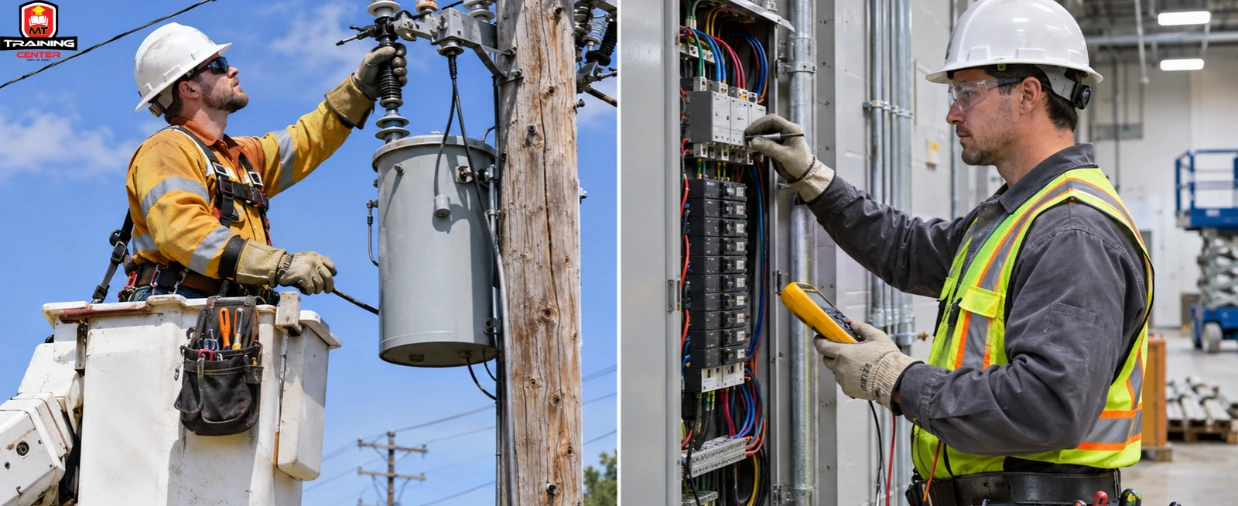
A lineman installs and repairs electrical power lines that deliver electricity to communities, while an electrician installs, maintains and repairs wiring and electrical systems in buildings. Linemen generally earn higher wages, but electricians have broader opportunities in residential, commercial and industrial work. Both careers offer apprenticeships and advancement opportunities without requiring a four-year college degree.
According to the U.S. Bureau of Labor Statistics (BLS), electrical power-line installers and repairers earned a median annual wage of $95,320 in May 2025, compared with $63,190 for electricians. However, higher pay comes with different workplace hazards, emergency schedules and physical demands.
Choosing between these skilled trades requires comparing training investment, earning potential, workplace conditions and long-term career goals.
Lineman vs. Electrician: What’s the Difference?
The main difference between a lineman and an electrician is the electrical infrastructure they work on. Both professionals work with electricity, but their responsibilities, training requirements and employment environments differ.
Lineman vs. Electrician Comparison Table
|
Comparison factor |
Lineman |
Electrician |
|
Primary responsibility |
Electrical power lines and utility equipment |
Building wiring and electrical equipment |
|
2025 median salary |
$95,320 |
$63,190 |
|
Typical education |
High school diploma or equivalent |
High school diploma or equivalent |
|
Typical training |
Employer programs up to 3 years; journey level often after 3–4 years |
4–5-year apprenticeship |
|
Work environment |
Utility poles, transmission towers, substations |
Homes, commercial buildings, factories |
|
Work schedule |
May include storms, emergencies and travel |
May include evenings, weekends and overtime |
|
Major hazards |
High voltage, elevated work, severe weather |
Electrical shock, burns, falls |
|
Career advancement |
Journeyman, foreman, supervisor |
Journeyman, master electrician, contractor |
|
Projected job growth, 2025–2035 |
10% |
9% |
|
Average annual job openings |
10,900 |
72,700 |
What Does a Lineman Do Compared to an Electrician?
Lineman vs electrician job duties differ in where electricity is delivered and used. Power line workers maintain utility infrastructure, while building electricians install and service electrical systems that distribute power within properties.
Lineman Job Duties: Transmission Lines and Power Distribution
An electrical lineman installs, maintains and repairs overhead and underground power lines. Some specialize in high-voltage transmission systems, while distribution lineworkers maintain equipment that delivers electricity to local customers.
Typical responsibilities include:
- Installing utility poles, conductors and power cables.
- Inspecting transformers, switches and voltage regulators.
- Maintaining electrical substations and distribution equipment.
- Identifying damaged lines and restoring electricity after outages.
- Using bucket trucks, climbing equipment and specialized testing tools.
Outside linemen often work in crews because lifting equipment, accessing energized systems and restoring damaged infrastructure require coordinated operations.
MT Training Center’s electrical lineworker training program introduces foundational knowledge of electrical distribution systems, utility equipment, field safety and lineworker responsibilities.
Electrician Job Duties: Wiring, Controls and Electrical Repairs
An electrician installs and troubleshoots electrical wiring, lighting systems, circuit breakers and building controls.
Responsibilities differ by specialization:
- Residential electricians work on home wiring, outlets, lighting and service panels.
- Commercial electricians install electrical systems in offices, stores and other commercial properties.
- Industrial electricians maintain motors, machinery, automation controls and industrial equipment.
- Inside wiremen commonly install and maintain electrical systems within buildings and industrial facilities.
For example, a commercial electrician might install the electrical distribution system in a new retail building, while an industrial electrician diagnoses a motor-control failure at a manufacturing plant.
Some related technical occupations also require electrical troubleshooting skills. For example, HVAC technician training covers electrical controls and equipment diagnostics, although HVAC-R technicians and licensed electricians follow different career pathways.
Lineman vs. Electrician Salary: Which Career Pays More?
Linemen typically earn more than electricians nationally. The BLS reported a $32,130 difference in median annual wages in May 2025, although individual earnings depend on experience, employer, location, overtime and specialization.
Lineman vs Electrician Salary by Experience and Industry
|
Wage measure |
Electrical power-line worker |
Electrician |
|
Lowest 10% earn below |
$51,470 |
$42,640 |
|
Median annual wage |
$95,320 |
$63,190 |
|
Highest 10% earn above |
$128,690 |
$108,510 |
These figures show occupational wage distributions, not guaranteed starting salaries. Apprentices typically receive lower wages than fully qualified professionals.
Employer type also matters. In May 2025, lineworkers employed by utilities earned a median $103,060, while electricians in manufacturing earned a median $74,550.
How Overtime, Union Agreements and Location Affect Pay
Overtime, union agreements, employee benefits and geographic demand can significantly influence total compensation.
A lineman assigned to storm restoration may earn additional overtime but spend several days away from home. An electrician working during an industrial shutdown may also earn overtime during scheduled maintenance.
Candidates should compare base hourly wages, overtime policies, healthcare, retirement benefits and travel allowances before accepting an offer.
Is the Higher Lineman Salary Worth It?
The higher national lineman salary may appeal to individuals comfortable with heights, weather exposure and unpredictable work assignments.
However, salary alone does not determine overall career value. A worker who prefers consistent local employment may consider an electrician position more suitable, even if its base salary is lower.
The better financial decision depends on compensation, personal priorities and the training investment needed to become fully qualified.
Lineman vs. Electrician Training: Education and Apprenticeships
Both occupations typically require a high school diploma or equivalent, technical instruction and supervised work experience. Linemen often complete employer-sponsored training or apprenticeships, while electricians commonly follow four- or five-year apprenticeship programs.
Students considering these careers can explore the vocational training programs in DeSoto, TX to compare available career-focused education pathways.
How to Become a Lineman After High School
An aspiring lineman can enter through an employer training program, registered apprenticeship or specialized vocational program.
Common steps include:
- Complete high school or an equivalent qualification, with attention to mathematics.
- Apply for a lineworker apprenticeship or approved training opportunity.
- Develop climbing, electrical distribution, equipment operation and rescue skills.
- Obtain a commercial driver’s license (CDL) when the position requires operating qualifying vehicles.
- Complete supervised field training and demonstrate journey-level competency.
Some employers require aptitude testing, physical assessments or substance screening.
For students seeking structured preparation, MT Training Center offers an Advanced Electrical Lineworker program in DeSoto, Texas.
The program includes 900 clock hours over 26 weeks of daytime classes or 36 weeks of evening classes. It introduces electrical theory, utility equipment, safety practices and lineworker fundamentals, preparing students to explore pre-apprentice and utility support opportunities. Completion does not automatically qualify a student as a journeyman lineworker.
MT Training Center
How to Become an Electrician Through Trade School or Apprenticeship
An aspiring electrician can attend electrical trade school or apply directly for an apprenticeship.
A typical pathway includes:
- Complete high school or an equivalent qualification.
- Study electrical theory, mathematics, wiring methods and safety procedures.
- Enter an apprenticeship combining classroom education with paid job experience.
- Complete required supervised working hours.
- Meet applicable state or local licensing requirements.
The BLS reports that electrician apprenticeships commonly last four or five years, with approximately 2,000 hours of paid on-the-job training annually.
The International Brotherhood of Electrical Workers (IBEW) and National Electrical Contractors Association (NECA) support apprenticeship training through the electrical training ALLIANCE.
Its published applicant information includes separate pathways for inside wiremen and outside linemen. Program duration and admission requirements depend on the specific training sponsor.
What Licensing and Certifications Are Required?
Most states require electricians to obtain a license, but the exact rules differ by jurisdiction.
Licensing examinations commonly address the National Electrical Code (NEC) and applicable state or local regulations. The National Fire Protection Association (NFPA) develops the NEC, which establishes electrical installation standards.
For example, Texas provides distinct apprentice, journeyman and master electrician licensing categories. Other states may use different classifications.
Lineworker requirements depend on employer qualifications, specialized training and applicable regulations. Workers operating qualifying heavy utility vehicles generally need an appropriate CDL.
Applicants interested in commercial driving qualifications can also review Class A CDL training in DeSoto, TX to understand the commercial vehicle training process. CDL training alone does not satisfy lineworker apprenticeship requirements.
Students considering MT Training Center should also review its vocational school admission requirements along with the specific program’s eligibility conditions.
Can Apprentices Earn Money During Training?
Yes. Registered apprenticeships combine paid employment, technical education and supervised experience.
Apprentices generally earn less than fully qualified workers, with wages increasing as their skills develop. Starting pay varies by occupation, location, employer and training agreement.
The U.S. Department of Labor’s Apprenticeship.gov helps candidates explore registered apprenticeship opportunities.
Before paying for a training program, candidates should verify tuition, equipment costs, employer partnerships and available financial assistance for vocational training. Eligibility and funding options depend on the applicant and program.
Which Job Is More Dangerous: Lineman or Electrician?
Both occupations involve potentially fatal electrical hazards. Lineworkers regularly encounter high-voltage equipment, heights and severe weather, while electricians face electrical shock, arc flash, falls and hazardous construction or industrial environments.
Without comparable exposure-adjusted injury data, neither occupation should be assigned a universal risk ranking.
Lineman Safety Risks
Lineworkers may work on utility poles, transmission towers and elevated platforms near energized electrical equipment.
Major risks include:
- Electrical contact and electrocution.
- Falls from poles, ladders and elevated platforms.
- Arc flash and thermal injuries.
- Storm-related hazards and difficult terrain.
- Fatigue during extended emergency restoration assignments.
The Occupational Safety and Health Administration (OSHA) establishes relevant workplace requirements under 29 CFR 1910.269 for covered electric power generation, transmission and distribution work.
Electrician Safety Risks
Electricians face hazards when installing, inspecting, testing or repairing electrical systems.
Electrical shock, burns, falls and equipment-related injuries are significant concerns. Protective measures include equipment isolation, voltage verification, personal protective equipment and applicable lockout/tagout procedures.
Safety rules depend on the task and work setting. OSHA regulates workplace safety, while the NEC primarily addresses electrical installation requirements.
How Do Working Conditions Affect Long-Term Safety?
Training, equipment, supervision and work practices directly influence safety in both occupations.
Lineworkers may require fall protection, insulated tools and specialized rescue procedures. Electricians may need arc-rated protective equipment, safe isolation procedures and protection against mechanical hazards.
The appropriate choice depends partly on a candidate’s physical abilities, comfort with workplace conditions and willingness to follow strict safety procedures.
Lineman vs. Electrician Job Outlook: Which Career Has Better Stability?
Both occupations have favorable employment projections through 2035. The BLS projects 10% growth for electrical power-line installers and 9% for electricians between 2025 and 2035, compared with approximately 3% for all U.S. occupations.
These national forecasts do not guarantee employment in a particular location.
Employment Growth and Annual Job Openings
|
BLS employment measure |
Lineman |
Electrician |
|
Estimated employment in 2025 |
131,900 |
821,000 |
|
Projected growth, 2025–2035 |
10% |
9% |
|
Average annual openings, 2025–2035 |
10,900 |
72,700 |
Electricians have substantially more projected annual openings because the occupation employs a much larger workforce.
Lineworkers remain essential to power distribution, utility maintenance and grid infrastructure.
Where Are the Employment Opportunities?
Linemen commonly work for utility companies, utility construction businesses and government agencies.
Electricians work across electrical contracting, manufacturing, maintenance, government and self-employment.
The BLS reported that approximately 66% of electricians worked for electrical and wiring installation contractors in 2025, while about 50% of lineworkers worked for utilities.
This distinction matters when candidates compare local employer availability and career flexibility.
How Will Grid Modernization Affect Both Careers?
Growing electricity demand, data center development and electrical grid upgrades are expected to support employment needs in both occupations.
Lineworkers help install and maintain transmission and distribution infrastructure. Electricians install and connect electrical systems serving buildings, equipment and power-generation technologies.
Future opportunities will differ by region and employer investment. Candidates should examine local market demand rather than assuming national growth will produce identical opportunities everywhere.
Lineman vs. Electrician Career Advancement: Which Offers More Options?
Both professions offer advancement beyond entry-level fieldwork. Lineworkers can progress into specialized assignments, crew supervision and training roles, while electricians can pursue advanced licensing, project management, technical specialization or electrical contracting.
Lineman Career Advancement
A lineworker typically progresses from apprentice to qualified journey-level worker.
Experienced professionals may become foremen, crew supervisors, safety trainers or utility operations leaders.
Additional qualifications may be necessary for specialized transmission work, advanced equipment operation or supervisory responsibilities.
Electrician Career Advancement
An experienced journeyman electrician may pursue master electrician credentials where available.
Other options include industrial automation, electrical estimating, project supervision, renewable energy installations and specialized maintenance.
These pathways allow professionals to develop technical expertise or move toward management roles.
Can Linemen and Electricians Start Their Own Businesses?
Both can establish businesses, subject to licensing, insurance, staffing and other legal requirements.
Electrical contractors may begin with smaller residential or commercial service projects, while utility-line contracting often requires substantial vehicles, equipment, staffing and specialized qualifications.
Business ownership should therefore be evaluated separately from the wage potential of an employed tradesperson.
Which Career Should Someone Choose: Lineman or Electrician?
A lineman career may suit someone who prioritizes higher national median earnings and enjoys demanding outdoor utility work. An electrician career may be more suitable for someone seeking multiple industry specializations, opportunities in building systems or a pathway toward electrical contracting.
The strongest decision considers five factors:
|
Decision factor |
Lineman may fit better when… |
Electrician may fit better when… |
|
Income |
Higher national median occupational pay is a priority |
Earnings are considered alongside specialization and local opportunities |
|
Training |
A lineworker apprenticeship or utility employer is accessible |
A building electrical apprenticeship is accessible |
|
Safety exposure |
Heights and outdoor utility conditions are acceptable |
Building or industrial electrical work is preferred |
|
Lifestyle |
Emergency assignments and possible travel are manageable |
Local work or a wider range of schedules is important |
|
Career flexibility |
Utility operations and crew leadership are appealing |
Contracting, industrial controls or business ownership are appealing |
Three Practical Career Scenarios
Scenario 1: A recent high school graduate prioritizing earnings
A graduate who enjoys working outdoors and is comfortable with heights may prefer a lineworker apprenticeship. However, the applicant should compare local openings and training requirements before assuming higher pay is immediately available.
Scenario 2: A career changer seeking local employment
Someone with family responsibilities may prefer building electrical work because local contractors, maintenance departments and industrial facilities offer varied employment settings. Schedule predictability still depends on the actual role.
Scenario 3: A student interested in eventually owning a company
An aspiring business owner may find electrical contracting attractive because residential and commercial work can support different service models. Licensing, experience, capital and customer acquisition remain necessary.
Students who want to compare different technical occupations can explore MT Training Center for available skilled trade programs, admission information and hands-on career training options.
Key Takeaways: Lineman vs. Electrician
- Salary: Lineworkers earned a higher national median annual wage in May 2025.
- Training: Both professions require technical instruction and substantial supervised experience.
- Job duties: Lineworkers maintain power delivery infrastructure; electricians install and repair building electrical systems.
- Safety: Both face serious hazards, with different exposure patterns.
- Employment: Both have positive projected growth through 2035.
- Career advancement: Lineworkers can pursue utility leadership, while electricians have broad technical and contracting opportunities.
- Best choice: Local job availability, workplace preferences and personal goals matter more than salary alone.
Prospective students should compare local apprenticeships, training providers, employer requirements, licensing rules and actual job offers before selecting a career.
Those interested in utility work can review the Advanced Electrical Lineworker training program in DeSoto, Texas to understand the curriculum, schedule and admission requirements. The program provides foundational preparation for entry-level opportunities rather than an electrician license or journeyman credential.
Frequently Asked Questions About Linemen and Electricians
Do linemen make more money than electricians?
Yes. The BLS reported median annual earnings of $95,320 for electrical power-line installers and $63,190 for electricians in May 2025. Individual wages vary by experience, employer, region, specialization and overtime.
Is it harder to become a lineman or an electrician?
Neither career is universally harder. Lineworkers require physical stamina, climbing ability and specialized utility training. Electricians need extensive knowledge of wiring, electrical systems and applicable codes. Both require practical experience and technical competence.
Can an electrician become a lineman?
Yes. An electrician can transition into utility linework, but building electrical experience does not automatically establish lineworker qualifications. Additional training, employer assessment, climbing instruction and potentially a lineworker apprenticeship may be required.
Can someone become a lineman or electrician without college?
Yes. Both careers commonly require a high school diploma or equivalent rather than a four-year college degree. Registered apprenticeships and employer-sponsored training provide practical routes into the workforce.
Which career has better job security?
Both have positive national employment projections. Electricians have more projected annual job openings, while lineworkers support essential utility infrastructure. Actual job security depends on local demand, employer stability, qualifications and economic conditions.
Can an electrician become a lineman without starting over?
Some transferable electrical knowledge may help, but previous experience does not guarantee credit toward a lineworker apprenticeship. Candidates should ask apprenticeship sponsors whether prior training or documented work experience qualifies for advanced placement.