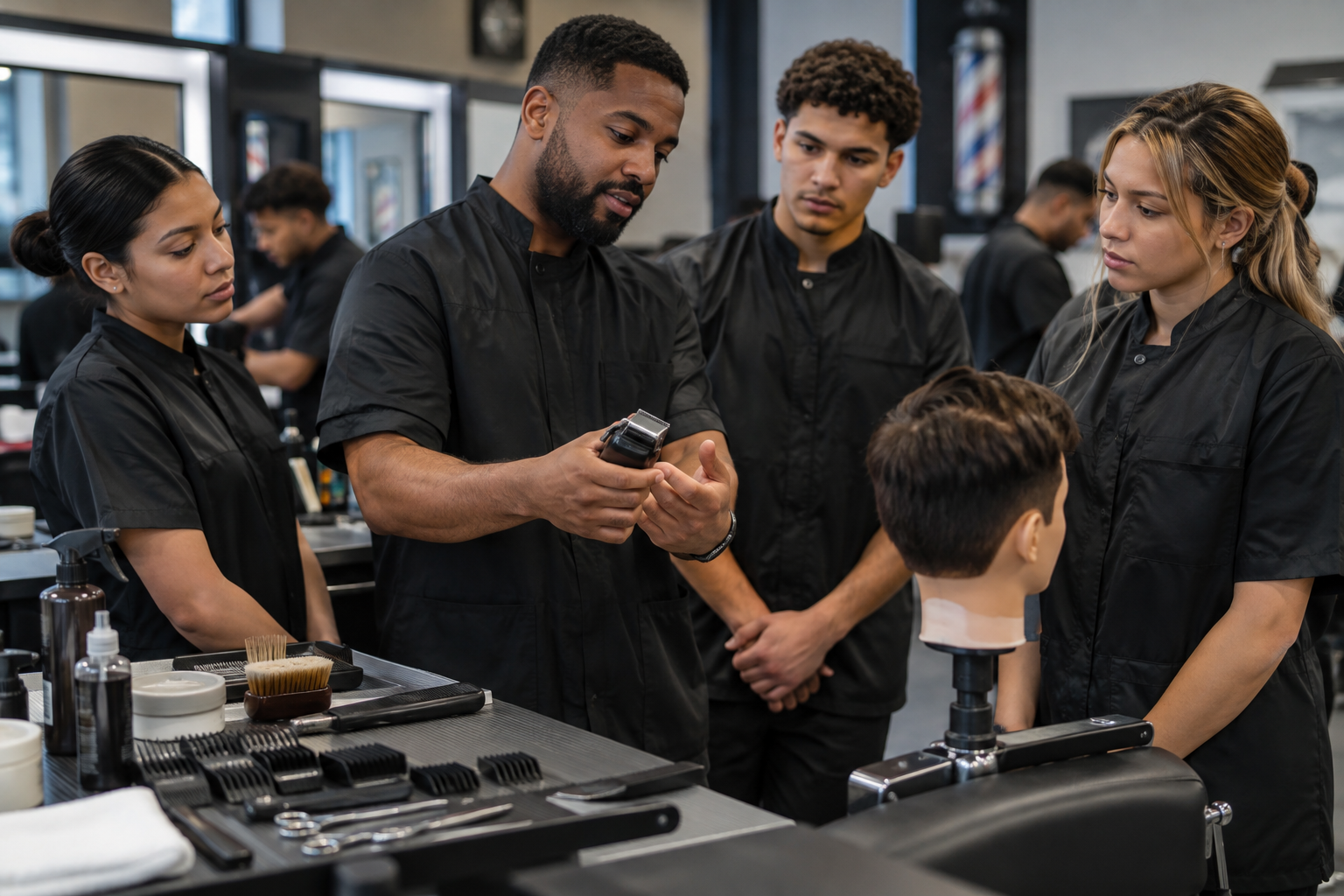
A Class A Barber training program prepares students for the technical, practical and professional demands of working in a barbershop environment.
The training goes beyond learning individual techniques. Students gradually build the knowledge, judgment and hands-on experience needed to perform services safely, work with different clients and prepare for professional barbering.
This guide explains the main areas covered in Class A Barber training and what students can expect to develop throughout the program.
What a Class A Barber Training Program Is Designed to Teach
Barber training should do more than show students how to complete a haircut. It develops tool control, service judgment, safety habits, client communication and technical consistency.
A beginner may initially focus on simply holding clippers correctly. With supervised practice, that same student learns to select guards, establish guidelines, blend transitions, refine the outline, check symmetry and evaluate the finished haircut from the client’s perspective.
Key Takeaways: What Students Learn in Class A Barber Training
- Clipper and shear haircutting
- Fades, tapers, blending and detailing
- Straight-razor shaving
- Beard and mustache grooming
- Hair and scalp analysis
- Shampooing, styling and finishing
- Hair coloring and chemical-service fundamentals
- Sanitation and infection control
- Client consultation and professional communication
- Barbering laws, ethics and licensing preparation
- Basic barbershop operations and career readiness
Haircutting Skills Form the Technical Core of Class A Barber Training
Students learn how to control clippers, shears, combs, guards, trimmers and razors while creating balanced shapes and clean finishes. Training commonly includes sectioning, guideline development, elevation, blending, clipper-over-comb, shear-over-comb, neckline work and detailing.
For example, producing a clean short haircut is not simply a matter of selecting one guard. A student must understand where weight should remain, where transitions begin, how the head shape affects the cut and how to correct visible lines without removing too much hair.
Fade and Taper Training Develops Controlled Blending Skills
Fade training teaches students how to create gradual transitions between different hair lengths. Students practice low, mid and high fades, along with controlled tapering around the temples and neckline.
The real skill is learning to diagnose an imperfect transition. When a visible weight line remains, the student must recognize whether the problem requires a different guard, lever position, clipper angle, or blending technique rather than repeatedly cutting the same area.
Straight-Razor Shaving Training Focuses on Control and Client Safety
Students learn safe razor handling, skin preparation, facial-hair growth patterns, shaving direction, blade positioning and sanitation procedures.
A professional shave requires more than removing facial hair. Students must control blade pressure and angle while recognizing sensitive areas where poor technique can cause irritation, cuts, or unnecessary skin trauma.
Beard and Mustache Training Builds Facial-Grooming Skills
Training covers beard trimming, shaping, lineups, mustache detailing, neckline placement and proportion.
Students also learn that facial-hair services should be customized. A strong beard shape for one client may look unbalanced on another because face shape, density, growth direction and existing length change how the service should be approached.
Hair and Scalp Training Helps Students Make Safer Service Decisions
Students learn to assess hair texture, density, condition, growth patterns and scalp health before beginning a service.
This matters because professional judgment sometimes means modifying or refusing a procedure. Recognizing an abnormal scalp condition, damaged hair, or another contraindication can prevent an inappropriate service and protect both the client and barber.
Shampooing and Styling Training Completes the Barbering Service
Students practice cleansing the hair and scalp, blow-drying, controlling direction and volume, selecting styling products and creating a polished finish.
Finishing is important because even a technically accurate haircut can appear incomplete when the hair is poorly dried, incorrectly directed, or overloaded with product.
Hair Coloring and Chemical Services Expand Technical Knowledge
Class A Barber education can include color theory, product application, chemical processing, hair assessment and service safety.
Students learn why chemical procedures require more caution than simply following product timing. Existing hair condition, previous chemical treatments, scalp sensitivity and desired results all affect whether a service can be performed appropriately.
Students interested in broader salon services can also compare barber training with MT Training Center’s Cosmetology Operator program.
Sanitation and Infection Control Are Part of Every Barber Service
Students learn how to disinfect tools, maintain clean workstations, prevent cross-contamination, handle reusable equipment and follow professional hygiene procedures.
These habits are not separate from haircutting or shaving. A barber may have excellent cutting technique, but poor infection-control practices can still place clients at risk.
Client Consultation Training Connects Technical Skill With Client Expectations
Students learn to ask what the client wants, assess hair characteristics, interpret reference photos, explain realistic outcomes and confirm the service before beginning.
Suppose a client requests a photo-perfect fade but has different density and growth patterns from the reference image. A trained barber should recognize those differences and explain how the style can be adapted rather than promising an identical result.
Professional Ethics and Barbering Laws Prepare Students for Licensed Practice
Students study professional conduct, client responsibilities, safety requirements and rules governing licensed barbering services.
In Texas, the Texas Department of Licensing and Regulation (TDLR) requires Class A Barber applicants to complete 1,000 hours of approved instruction and pass both written and practical examinations.
Barbershop Business Training Introduces the Professional Side of the Career
Students may also develop foundational skills in appointment management, customer retention, professional presentation, product knowledge, workplace communication and shop operations.
These skills matter because technical ability gets a client through the chair once; professionalism, communication and consistent service help bring that client back.
Practical Training Turns Barbering Theory Into Behind-the-Chair Ability
Hands-on practice allows students to apply classroom concepts through mannequins, demonstrations, supervised exercises and client services where available.
Repetition is critical. Performing one fade correctly shows understanding; performing similar services consistently across different hair types demonstrates developing professional competency.
Class A Barber Skills, Training Purpose and Career Application
| Training Area | Students Practice | Professional Application |
| Haircutting | Clippers, shears, blending | Core barber services |
| Fades | Guidelines and transitions | Modern short hairstyles |
| Razor work | Preparation and blade control | Facial shaving |
| Beard grooming | Trimming and shaping | Facial-hair services |
| Hair analysis | Texture and condition | Safer service planning |
| Sanitation | Disinfection procedures | Client protection |
| Consultation | Needs assessment | Better service outcomes |
| Business skills | Client management | Career development |
Class A Barber Training in Texas Requires 1,000 Instructional Hours
Texas requires 1,000 hours of Class A Barber instruction at a licensed barbering or cosmetology school. Students can become eligible for the written licensing examination after completing 900 hours, while practical-exam eligibility follows completion of the required course hours and written examination requirements.
This structure reinforces an important point: training is designed to develop both knowledge and practical competency rather than treating barbering as a single skills test.
Licensing Exam Preparation Reinforces What Students Learn During Training
Written preparation reinforces barber theory, sanitation, safety and applicable regulations, while practical preparation focuses on performing required procedures correctly.
The distinction matters. TDLR’s FY2025 statistics reported a 37.25% Class A Barber written-exam pass rate, compared with an 89.80% practical-exam pass rate, showing why students should take theoretical preparation seriously alongside hands-on work.
What Students Should Be Able to Do After Class A Barber Training
By completion, a prepared student should be developing the ability to:
- Perform common clipper and shear haircuts
- Execute fades, tapers, outlines and detailing
- Groom beards and mustaches
- Perform razor services safely
- Maintain sanitary tools and workstations
- Conduct professional consultations
- Apply barbering safety and professional standards
Graduation alone does not replace state licensing requirements, but structured training establishes the technical foundation required to move toward professional practice.
How to Compare Class A Barber Training Programs Before Enrolling
Compare programs by examining hands-on training opportunities, curriculum coverage, instructor support, licensing preparation, facilities, scheduling, equipment and opportunities to practice practical services.
Career changers comparing multiple vocational directions can also explore MT Training Center’s Combination Welding, CNC Machinist, Computerized Accounting and broader vocational training programs before choosing a training path.
Frequently Asked Questions
Do You Learn Fades in a Class A Barber Program?
Yes. Class A Barber training typically includes fades, tapers, clipper control, blending, guideline removal and finishing techniques so students can build the precision required for modern short hairstyles.
Students also practice adapting fades to different hair densities, growth patterns and head shapes instead of relying on one fixed technique.
Do Barber Students Learn Straight-Razor Shaving?
Yes. Students learn straight-razor shaving techniques, including blade handling, skin preparation, shaving direction, sanitation and client safety as part of professional barber training.
They also learn how blade angle, pressure, facial-hair growth and skin sensitivity affect both safety and the final result.
Do Class A Barbers Learn Hair Coloring?
Yes. Class A Barber training can include hair coloring, color theory, product application, chemical processing and safety procedures related to professional color services.
Students also learn how hair condition, previous chemical treatments and scalp sensitivity can influence whether and how a color service should be performed.
Does Completing Barber School Automatically Make You a Licensed Barber?
No. Completing barber school does not automatically make you a licensed barber. Students must complete the required education and meet the applicable written, practical and state licensing requirements.
Training prepares students for professional practice, while licensure confirms that they have met the legal standards required to work as a barber.
What Does a Barber Do for Class 1?
A Class A Barber performs professional services such as haircutting, fading, tapering, shaving, beard and mustache grooming, hair styling and certain hair and scalp services permitted under state regulations.
The role also involves client consultation, sanitation, tool disinfection, service planning and maintaining professional safety standards throughout every appointment.
What Skills Does a Barber Need?
A barber needs clipper control, shear cutting, blending, fading, razor handling, beard shaping, sanitation, client communication, attention to detail and strong hand-eye coordination.
Professional barbers also need judgment. They must be able to evaluate hair texture, growth patterns, face shape and client expectations before deciding how to approach each service.
How Long Is a Barbering Course?
The length of a barbering course depends on the state requirement, school schedule and whether the student attends full-time or part-time. In Texas, the standard Class A Barber education pathway requires 1,000 instructional hours.
A full-time student may complete those hours much faster than someone attending evenings or part-time, so calendar length can vary even when the required training hours remain the same.
How Many Years of Training Does It Take to Be a Barber?
Barber training usually takes less than two years, although the exact duration depends on required instructional hours and the student’s weekly schedule. In Texas, students must complete 1,000 hours of approved Class A Barber education.
Because barber programs are measured primarily in training hours rather than academic years, two students can finish at different times depending on how many hours they attend each week.