Before choosing an HVAC school, you probably want to know what you will actually be doing in class.
Will you spend your time reading about air conditioners, or will you test electrical circuits, work with heating and refrigeration equipment, take pressure and temperature readings, use diagnostic tools, and troubleshoot problems?
A good HVAC technician certificate program combines technical knowledge with hands-on practice. Students typically learn refrigeration, electricity, heating systems, controls, airflow, maintenance, safety, and troubleshooting so they can begin developing the skills needed for entry-level HVAC work.
This guide explains what you can expect to learn, what hands-on HVAC training looks like, which certifications are separate from your school certificate, and how to judge whether a program is right for you.
What Is an HVAC Technician Certificate Program?
An HVAC technician certificate program is career-focused training designed to teach the fundamentals of heating, ventilation, air conditioning, and refrigeration systems.
Unlike a traditional four-year degree, the training concentrates on technical concepts and practical skills related to HVAC service and equipment.
The U.S. Bureau of Labor Statistics reports that heating, air-conditioning, and refrigeration mechanics and installers typically enter the occupation with a postsecondary nondegree award and continue learning through substantial on-the-job training after employment begins.
If you are new to the terminology, start with MT Training Center’s guide explaining what HVAC-R means and the difference between HVAC and HVACR.
What Do You Learn in HVAC School?
HVAC students typically learn how refrigeration, electricity, controls, heating, airflow, and mechanical components work together.
Common areas of study include:
- Refrigeration theory
- Heating and cooling systems
- Electrical circuits
- Motors and controls
- Airflow and ventilation
- System components
- Diagnostic testing
- Preventive maintenance
- HVAC tools
- Safety procedures
- Troubleshooting
The goal is not just to recognize equipment. Students need to begin understanding why a system behaves a certain way and how to investigate a problem logically.
MT Training Center’s Advanced HVAC-R Technician Certificate Program currently includes 600 clock hours, divided equally between 300 lecture hours and 300 laboratory hours. Its curriculum focuses on refrigeration, electricity and controls, and gas and electric heating.
1. Refrigeration and the Cooling Cycle
Refrigeration is one of the foundations of air conditioning and HVAC-R work.
Students learn how heat moves through a system and how refrigerant travels through components such as:
- Compressors
- Condensers
- Evaporators
- Metering devices
- Refrigerant lines
A basic refrigeration cycle involves compression, condensation, expansion, and evaporation.
Knowing the cycle is important because technicians use temperature, pressure, airflow, and equipment behavior to understand whether a cooling system is operating correctly.
MT Training Center’s HVAC-R curriculum also covers compressor types, condensers, evaporators, metering devices, humidity, and tool and equipment safety.
2. Electricity and HVAC Controls
One of the biggest surprises for some beginners is how much electrical knowledge HVAC technicians need.
Modern HVAC systems rely on electrical circuits and controls to operate motors, compressors, fans, thermostats, and safety devices.
Students may learn about:
- Voltage
- Amperage
- Resistance
- Ohm’s Law
- Electrical circuits
- Motors
- Capacitors
- Relays
- Contactors
- Transformers
- Wiring diagrams
- Electrical meters
For example, a technician may need to read a wiring diagram, locate a component, test it with a meter, compare the reading with normal operation, and determine whether the electrical component is causing the system failure.
MT Training Center dedicates 100 lecture hours and 100 laboratory hours specifically to Fundamentals of Electricity and Controls.
3. Gas and Electric Heating Systems
HVAC training is not limited to air conditioning.
Students also need to understand how heating equipment operates.
Topics may include:
- Gas furnaces
- Electric heating
- Heating components
- Blower controls
- Furnace construction
- Venting
- Forced-air systems
- Unit heaters
- Heating system safety
A key concept is the sequence of operation.
If a furnace will not start, the technician needs to identify where the normal operating sequence stopped. That may involve checking electrical power, controls, ignition components, airflow, or safety devices.
MT Training Center’s curriculum includes 200 combined lecture and lab hours devoted to gas and electric heating.
4. Airflow, Ventilation, and System Performance
Not every cooling problem is caused by refrigerant.
Restricted airflow can make an HVAC system perform poorly even when major mechanical components are operating.
Students may learn about:
- Supply and return airflow
- Filters
- Duct systems
- Blower operation
- Ventilation
- Temperature differences
- Humidity
- Air distribution
This teaches an important diagnostic lesson: look at the complete system before deciding what is wrong.
For example, poor cooling could result from a restricted filter, dirty coil, blower problem, electrical issue, refrigerant condition, or another fault.
5. HVAC Maintenance and Service Skills
Preventive maintenance is another important part of HVAC work.
Students may practice:
- Inspecting equipment
- Cleaning components
- Checking filters
- Examining electrical connections
- Testing controls
- Measuring temperatures
- Checking system operation
- Identifying worn components
- Recording service information
Good maintenance training also teaches students to use a repeatable process instead of jumping to conclusions.
How Do HVAC Students Learn Troubleshooting?
Troubleshooting is where the different parts of HVAC training begin to connect.
A technician might follow a process such as:
- Confirm the reported problem.
- Inspect the equipment.
- Check basic operating conditions.
- Test electrical components.
- Check airflow.
- Take temperature or pressure readings when appropriate.
- Compare results with expected system operation.
- Identify the likely cause.
- Correct or report the problem.
- Test the system again.
Consider an air conditioner that is running but not cooling properly.
Adding refrigerant without diagnosing the system would be poor troubleshooting. The technician may first need to check the filter, airflow, coils, electrical controls, temperatures, pressures, and other system conditions.
Learning to diagnose instead of guess is one of the most valuable skills students can begin developing in HVAC school.
Is HVAC Technician Training Hands-On?
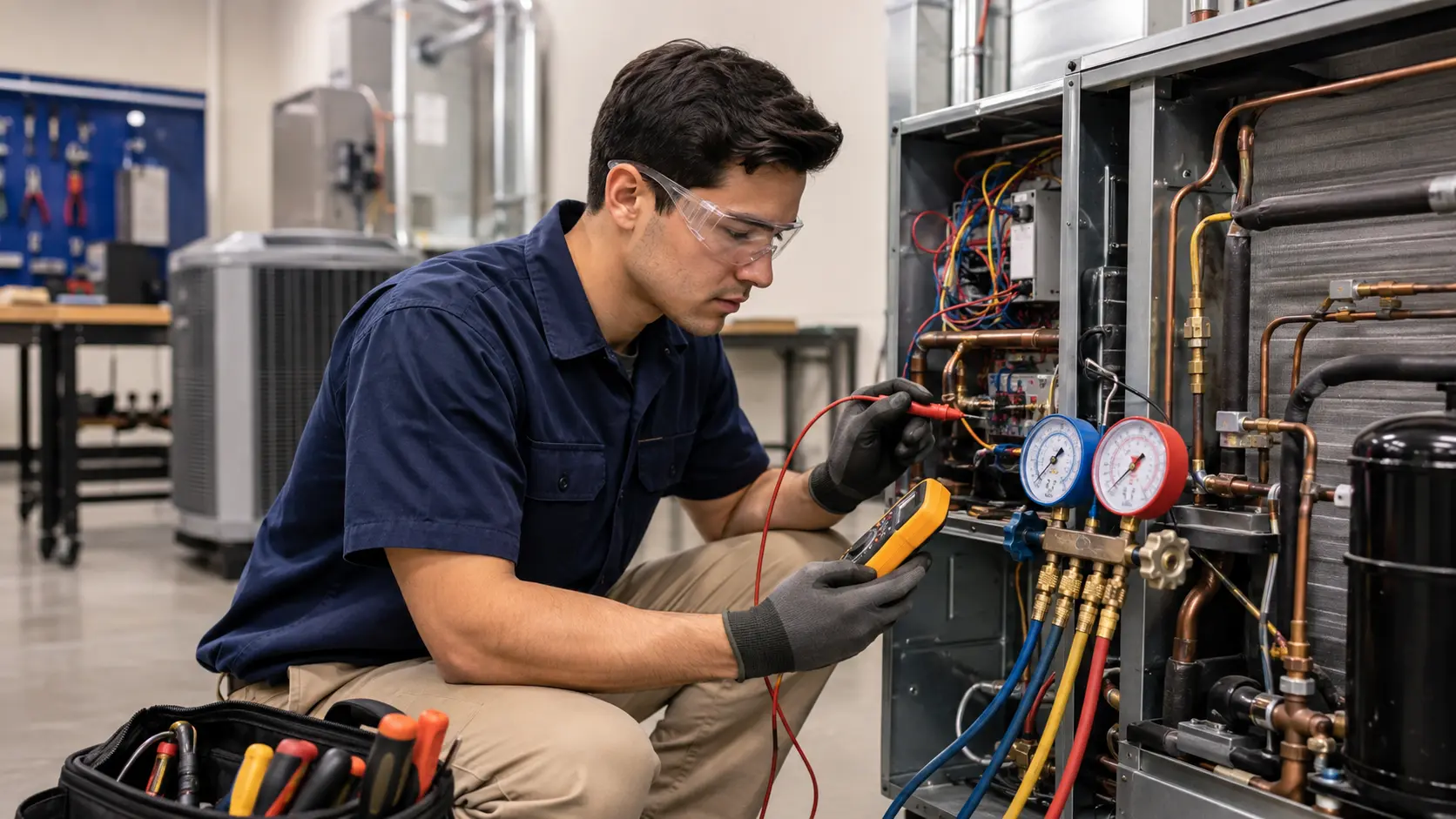
A strong HVAC program should combine classroom learning with practical laboratory experience.
Reading about a capacitor explains what it does. Testing one helps a student understand how that knowledge is used during diagnosis.
Hands-on training may include:
- Reading wiring diagrams
- Using electrical meters
- Testing circuits
- Measuring temperatures
- Taking refrigeration system readings
- Identifying components
- Inspecting heating equipment
- Practicing maintenance procedures
- Diagnosing training faults
- Following safety procedures
At MT Training Center, the HVAC-R curriculum is divided evenly between 300 classroom hours and 300 laboratory hours, allowing students to connect theory with practical training.
What HVAC Tools Do Students Learn to Use?
The exact tools vary by program, but students may become familiar with equipment such as:
| Tool | What It Helps a Technician Do |
| Multimeter | Test voltage, resistance, and continuity |
| Clamp meter | Measure electrical current |
| Manifold gauges | Check refrigeration system pressures |
| Thermometer | Measure air and equipment temperatures |
| Vacuum pump | Remove air and moisture from a system |
| Recovery equipment | Recover refrigerant properly |
| Leak detector | Help locate refrigerant leaks |
| Tubing tools | Work with refrigeration tubing |
| Hand tools | Access, assemble, and service components |
Knowing how to hold a tool is not enough. Students also need to understand which measurement to take and what that measurement tells them about the system.
HVAC Safety Is Part of the Training
HVAC technicians can work around electricity, combustible fuels, refrigerants, moving equipment, ladders, hot surfaces, and heavy components.
Safety training may address:
- Electrical hazards
- Personal protective equipment
- Refrigerant handling
- Gas heating safety
- Equipment shutdown procedures
- Safe tool use
- Venting
- Lifting and ladder practices
This is not a minor part of the trade. BLS reports that HVAC technicians have one of the higher rates of occupational injuries and illnesses, making safe work practices particularly important.
HVAC Technology Is Changing
HVAC training does not stop being relevant when new equipment enters the market.
The refrigerant landscape, for example, is changing. EPA rules are driving parts of the refrigeration and air-conditioning industry toward lower global warming potential refrigerants, and newer residential and light-commercial systems increasingly use different refrigerant technologies.
For new technicians, this reinforces an important point: HVAC is a field where continued learning matters.
The fundamentals of refrigeration, electrical systems, safety, controls, and diagnostics create a base that technicians can continue building on as equipment and regulations change.
Does HVAC School Make You EPA Certified?
Not automatically.
A school Certificate of Completion and EPA Section 608 Technician Certification are different credentials.
EPA requires technicians performing covered work that could release regulated refrigerants to pass an EPA-approved Section 608 examination. Different certification types apply depending on the equipment involved.
Before enrolling in any HVAC program, ask how the school addresses refrigerant certification preparation and testing.
HVAC Certificate, EPA Certification, and Texas Registration Are Different
These terms can be confusing, especially for beginners.
| Credential | What It Means |
| School Certificate of Completion | Shows that you completed the school’s training program |
| EPA Section 608 Certification | Federal refrigerant-handling credential for covered work |
| TDLR Registered Technician | Texas designation for technicians performing covered work under a licensed contractor |
| TDLR Certified Technician | Voluntary Texas designation with additional training or experience and examination requirements |
| Contractor License | Separate Texas license with experience and other requirements |
In Texas, technicians performing covered air-conditioning and refrigeration maintenance or repair work generally must be registered or certified and work under a licensed contractor, subject to applicable exemptions.
MT Training Center’s guide to becoming an HVAC technician in Texas explains this career path in more detail.
What HVAC School Cannot Teach You by Itself
This is just as important as understanding what school does teach.
Completing an HVAC certificate program does not mean you will immediately know every brand, system, control board, refrigerant, installation method, or jobsite situation.
BLS notes that technicians typically continue through substantial on-the-job training after entering the field.
School helps build the foundation.
Experience helps you become faster at diagnosing unusual problems, communicating with customers, working independently, understanding different equipment, and adapting to real service situations.
This is why a good training program should teach how systems work and how to think through problems, not just how to perform one repair.
What Skills Matter Besides Technical Knowledge?
Employers also need technicians who can solve problems, notice details, adapt, and communicate professionally.
BLS identifies detail orientation, problem solving and decision making, and adaptability among the key skills associated with HVAC mechanics and installers.
Those qualities matter when you are:
- Diagnosing an intermittent problem
- Explaining a repair to a customer
- Following safety procedures
- Documenting service work
- Working with other technicians
- Encountering unfamiliar equipment
A technician who understands the system but ignores details can still make costly mistakes.
What Can You Do After HVAC Training?
HVAC training can help prepare students for entry-level opportunities involving heating, air conditioning, refrigeration, installation, maintenance, and service.
BLS reports that HVAC mechanics and installers had a median annual wage of $59,810 in May 2024. Employment is projected to grow 8 percent from 2024 to 2034, compared with 3 percent for all occupations. BLS projects about 40,100 openings per year on average during that period. Actual wages and opportunities depend on location, experience, employer, credentials, and specialization.
How to Choose an HVAC Technician Certificate Program
Before enrolling, ask more than, “How quickly can I finish?”
Compare:
- How many hours are hands-on?
- Does the curriculum teach refrigeration?
- How much electrical training is included?
- Will you practice troubleshooting?
- What heating systems are covered?
- What equipment and tools are available in the lab?
- How does the school address EPA Section 608 preparation?
- What credential do you receive after graduation?
- Is the school accredited or state regulated?
- What are the total tuition and fees?
- What financial aid may be available?
- What are the admissions requirements?
MT Training Center is accredited by the Council on Occupational Education and approved and regulated by the Texas Workforce Commission Career Schools and Colleges Section.
Prospective students can review MT Training Center’s admissions requirements and financial aid information before deciding whether the program fits their circumstances. Federal student aid eligibility depends on individual requirements.
Is HVAC Training Right for You?
HVAC may be worth exploring if you like:
- Solving practical problems
- Working with tools
- Understanding mechanical systems
- Learning electrical concepts
- Finding out why equipment fails
- Working in different environments
- Learning through hands-on practice
It is also a career where learning continues after school.
If that combination fits you, review MT Training Center’s Advanced HVAC-R Technician Certificate Program in DeSoto, Texas to compare the current curriculum, lab structure, admissions requirements, costs, and class options.
Frequently Asked Questions
What do you learn in HVAC school?
HVAC students typically learn refrigeration, electricity, heating and cooling systems, controls, airflow, maintenance, safety, tools, and troubleshooting. Programs may combine classroom instruction with hands-on laboratory practice.
Is HVAC school difficult for beginners?
HVAC training introduces mechanical, electrical, and refrigeration concepts that may be unfamiliar at first. Programs designed for beginners usually teach foundational concepts before moving into more advanced diagnosis and practical work.
Do HVAC technicians need to know electricity?
Yes. Motors, compressors, thermostats, capacitors, relays, contactors, transformers, and control circuits all depend on electricity. Electrical knowledge is an important part of HVAC troubleshooting.
Do you need to be good at math for HVAC?
HVAC work uses practical math for electrical calculations, measurements, temperatures, pressures, airflow, and other system readings. Students generally use math in the context of actual HVAC applications rather than advanced theoretical mathematics.
Is HVAC training hands-on?
Many career-focused HVAC programs include laboratory training where students practice testing, measuring, identifying components, troubleshooting, and working with HVAC equipment. Ask each school how its classroom and lab hours are divided.
Does completing HVAC school make you EPA certified?
No. An HVAC school certificate and EPA Section 608 certification are separate credentials. Technicians performing covered refrigerant work must pass an EPA-approved Section 608 examination.
Can you become an HVAC technician with no experience?
Yes. Many people begin by completing vocational training or entering supervised employment. BLS states that HVAC technicians typically continue developing their skills through substantial on-the-job training after entering the occupation.
How long does HVAC technician training take?
Training length varies by school and program. MT Training Center’s Advanced HVAC-R program is currently listed at 600 clock hours with day and evening class options. Prospective students should confirm the current schedule directly with the school before enrolling.