If you have been researching careers in heating and cooling, you may have come across terms such as HVAC, HVACR, HVAC-R, and HVAC/R. They sound similar, but there is one important difference.
HVAC-R stands for heating, ventilation, air conditioning, and refrigeration. Standard HVAC focuses mainly on heating, cooling, ventilation, and indoor comfort. HVACR includes those areas plus refrigeration systems used to keep food, products, equipment, and controlled spaces at specific temperatures.
For someone considering HVAC training, understanding that extra “R” matters. It can affect the equipment you learn to work with, the skills you develop, and the types of jobs you may eventually pursue.
This guide explains HVAC vs HVACR in simple terms, how refrigeration works, the equipment technicians encounter, career requirements, and what beginners typically learn in HVAC-R training.
What Does HVAC-R Stand For?
HVAC-R stands for:
- H: Heating
- V: Ventilation
- AC: Air Conditioning
- R: Refrigeration
You may see the industry described as HVACR, HVAC-R, or HVAC/R. These variations generally refer to the same combination of heating, ventilation, air conditioning, and refrigeration.
Here is what each part means.
Heating
Heating systems maintain comfortable indoor temperatures during colder conditions.
Common systems include furnaces, heat pumps, and electric or gas heating equipment. HVAC technicians need to understand how these systems produce and distribute heat and how to identify problems when they stop operating correctly.
Ventilation
Ventilation controls how air moves through a building.
Ductwork, fans, filters, vents, and air-handling equipment help bring in, circulate, and remove air. Proper airflow also plays an important role in comfort, humidity control, and indoor air quality.
Air Conditioning
Air-conditioning systems remove heat from indoor spaces to maintain comfortable temperatures.
Although residential AC systems may be the most familiar example, cooling systems are also found in schools, offices, stores, medical facilities, industrial spaces, and many other buildings.
Refrigeration
Refrigeration is the additional area represented by the R in HVACR.
Rather than primarily keeping people comfortable, refrigeration systems often maintain specific temperatures for food, beverages, medicine, commercial products, or storage spaces.
Examples include:
- Walk-in coolers
- Commercial freezers
- Refrigerated display cases
- Ice machines
- Food-storage equipment
- Other commercial refrigeration systems
HVAC vs HVACR: What Is the Difference?
The main difference between HVAC and HVACR is refrigeration.
| Area | HVAC | HVACR |
| Heating | Yes | Yes |
| Ventilation | Yes | Yes |
| Air conditioning | Yes | Yes |
| Refrigeration | Not usually the primary focus | Yes |
| Residential heating and cooling | Common | Common |
| Commercial refrigeration | Less common | Common |
| Walk-in coolers and freezers | Usually outside core HVAC work | Common HVACR equipment |
The distinction is not always absolute. HVAC and refrigeration use many of the same principles, including heat transfer, refrigerants, compressors, condensers, evaporators, electrical controls, and system diagnostics.
That is why some technicians work across both areas while others specialize.
The U.S. Bureau of Labor Statistics groups heating, air-conditioning, and refrigeration mechanics and installers within the same occupational category and notes that technicians may specialize in areas such as commercial refrigeration.
Why Is Refrigeration Different From Air Conditioning?
This is one of the most common points of confusion for beginners.
If air conditioners already cool air, why is refrigeration considered separately?
The key difference is usually the purpose of the cooling.
An air-conditioning system typically controls the temperature and comfort of an occupied space. A refrigeration system is designed to remove heat so that products or enclosed spaces can remain at lower, controlled temperatures.
Think about a grocery store.
The store may use HVAC equipment to keep customers comfortable. At the same time, separate refrigeration systems keep frozen foods, dairy products, drinks, and other temperature-sensitive items at appropriate temperatures.
The underlying science overlaps, but the equipment, applications, controls, temperatures, and service requirements can differ.
How Does an HVACR Refrigeration System Work?
Most refrigeration and air-conditioning systems operate by moving heat rather than creating cold.
A simplified refrigeration cycle uses four major components:
- Compressor: Compresses and circulates refrigerant through the system.
- Condenser: Allows the refrigerant to release heat.
- Expansion or metering device: Reduces refrigerant pressure before it enters the evaporator.
- Evaporator: Allows the refrigerant to absorb heat from the area being cooled.
The refrigerant continues moving through this cycle while the system operates.
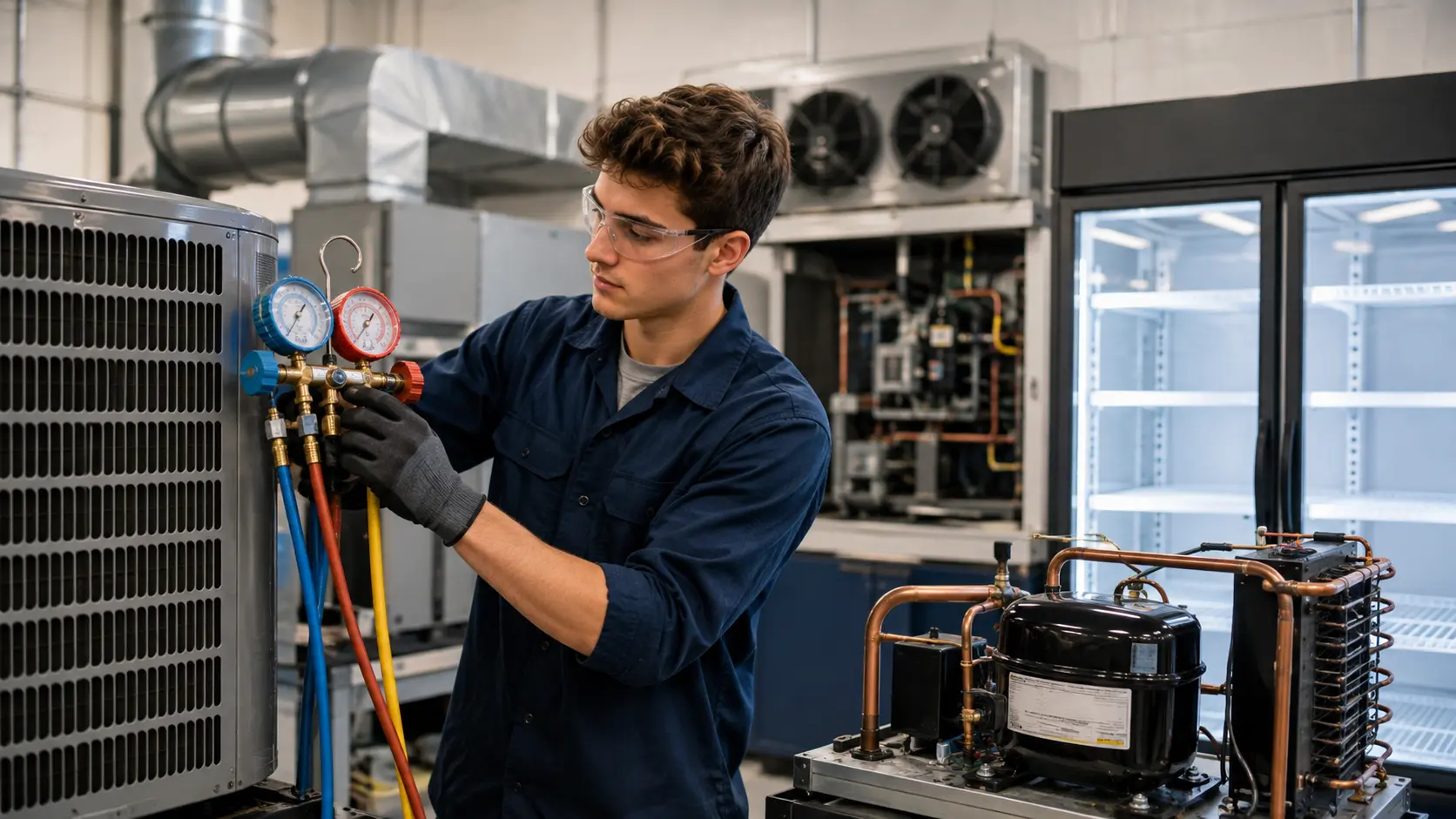
For a technician, however, understanding the refrigeration cycle is only one part of the job. Diagnosing equipment may also require knowledge of electricity, wiring, motors, controls, airflow, temperature, pressure, safety procedures, and diagnostic tools.
What Equipment Do HVACR Technicians Work On?
The equipment an HVACR technician works with depends on the employer, specialization, and type of facility.
Common examples include:
- Central air conditioners
- Furnaces
- Heat pumps
- Air handlers
- Ventilation systems
- Electrical controls
- Commercial refrigeration units
- Walk-in coolers
- Freezers
- Refrigerated cases
- Ice machines
Not every technician works on all of these systems.
A residential technician may spend most of the day servicing home heating and cooling equipment. A commercial refrigeration technician may work more often with restaurant, grocery, hospitality, or food-storage systems.
Where Are HVACR Systems Used?
HVACR equipment appears almost everywhere temperature control is important.
Residential Buildings
Homes commonly use furnaces, heat pumps, air conditioners, duct systems, thermostats, and other HVAC equipment.
Restaurants and Grocery Stores
These businesses need both indoor comfort systems and refrigeration equipment. A restaurant may have rooftop HVAC equipment along with walk-in coolers, freezers, ice machines, and refrigerated food-storage systems.
Schools and Offices
Large buildings rely on heating, cooling, airflow, and control systems to maintain comfortable conditions across multiple rooms and occupied spaces.
Hospitals and Other Facilities
Hospitals, healthcare facilities, warehouses, hotels, and other commercial buildings can rely on more complex climate-control and refrigeration equipment.
The wide variety of systems is one reason HVACR technicians need both technical knowledge and strong troubleshooting skills.
What Does an HVACR Technician Actually Do?
An HVACR technician may install, inspect, maintain, diagnose, and repair heating, cooling, ventilation, or refrigeration equipment.
Common responsibilities can include:
- Inspecting systems and components
- Testing electrical circuits
- Reading wiring diagrams
- Taking temperature or pressure measurements
- Diagnosing system problems
- Repairing or replacing faulty components
- Performing preventive maintenance
- Checking airflow
- Working with controls and motors
- Handling refrigerants when appropriately certified
- Explaining equipment problems to customers
One of the most important skills is troubleshooting.
A technician should not simply replace parts until the equipment begins working. The goal is to observe the symptoms, take measurements, understand how the system should operate, identify the likely cause, and verify that the repair corrected the problem.
HVAC Technician vs HVACR Technician
An HVAC technician generally works with heating, ventilation, and air-conditioning systems.
An HVACR technician may work with those systems while also having training related to refrigeration equipment.
In practice, employers may use the job titles differently. Some jobs advertised as HVAC technician positions include refrigeration responsibilities, while other technicians specialize almost completely in commercial refrigeration.
For beginners, the more useful question is not simply which title is better. It is what systems and skills the training program actually covers.
What Do You Learn in HVAC-R Training?
A strong HVAC-R education should help students understand how mechanical, electrical, heating, cooling, and refrigeration systems work together.
Training may cover:
- Refrigeration theory
- Temperature and pressure
- Electrical circuits
- Motors and controls
- Gas and electric heating
- System components
- Airflow
- Safety procedures
- Diagnostic testing
- Troubleshooting
MT Training Center’s Advanced HVAC-R Program in DeSoto, Texas includes 600 clock hours of instruction, divided between classroom and laboratory training. Its current curriculum covers basic refrigeration theory, electricity and controls, and gas and electric heating, with practical work connected to residential and commercial equipment.
That hands-on component matters because learning the names of HVAC components is different from learning how to test, diagnose, and work with an actual system.
If you are comparing programs, MT Training Center’s guide to what you learn in an HVAC technician certificate program provides a more detailed breakdown of classroom topics, practical training, electrical skills, diagnostics, and troubleshooting.
Do HVACR Technicians Need EPA Certification?
Working in HVACR can involve refrigerants, and that introduces specific federal requirements.
The U.S. Environmental Protection Agency states that technicians who maintain, service, repair, or dispose of equipment in ways that could release regulated refrigerants must obtain EPA Section 608 Technician Certification by passing an EPA-approved test.
EPA currently recognizes:
- Type I: Small appliances
- Type II: High-pressure and very high-pressure appliances, except small appliances and motor vehicle AC
- Type III: Low-pressure appliances
- Universal: All equipment covered by the three types
An HVAC school certificate and EPA Section 608 certification are different credentials.
That distinction is important when comparing training programs or planning a career.
What Are the HVAC Technician Requirements in Texas?
Texas also has state-level requirements for people performing air-conditioning and refrigeration work.
The Texas Department of Licensing and Regulation states that a person assisting a licensed air-conditioning and refrigeration contractor with maintenance or repair generally must register as a technician and work under the supervision of a licensed contractor, subject to applicable exemptions.
Because registration, technician certification, EPA certification, and contractor licensing are different things, beginners can easily become confused.
MT Training Center’s step-by-step guide to becoming an HVAC technician in Texas explains these pathways in more detail, including training, TDLR requirements, EPA certification, and future career progression.
Is HVACR a Good Career to Consider?
HVACR can be worth exploring for someone who enjoys:
- Working with tools and equipment
- Solving practical problems
- Understanding mechanical systems
- Learning electrical concepts
- Working in different environments
- Diagnosing why equipment is not functioning correctly
It is also important to understand the realities of the work. HVACR technicians may work outside, inside mechanical spaces, in hot or cold conditions, or during busy seasonal periods.
Current U.S. Bureau of Labor Statistics data provides some useful career context. The median annual wage for heating, air-conditioning, and refrigeration mechanics and installers was $59,810 in May 2024. Employment is projected to grow 8 percent from 2024 to 2034, with about 40,100 openings per year on average over that period. Actual earnings and opportunities vary by location, experience, employer, credentials, and specialization.
How to Decide Whether HVAC-R Training Is Right for You
Before choosing an HVAC-R program, do more than compare tuition.
Ask:
- Does the program include hands-on laboratory training?
- Does it teach both HVAC and refrigeration?
- Will you learn electrical systems and controls?
- Does the curriculum include troubleshooting?
- Does the school explain certification requirements clearly?
- What residential and commercial equipment will you encounter?
- What are the program length and class schedule?
- Is the school accredited or state approved?
- What financial assistance options may be available?
MT Training Center is accredited by the Council on Occupational Education and approved and regulated by the Texas Workforce Commission Career Schools and Colleges Section.
Students comparing the cost of career training can also review MT Training Center’s financial aid information to learn about FAFSA and available assistance for eligible students.
The Bottom Line: HVAC vs HVACR
HVAC means heating, ventilation, and air conditioning. HVACR adds refrigeration.
That single letter expands the field beyond indoor comfort systems into equipment such as commercial coolers, freezers, refrigerated displays, and other temperature-controlled systems.
For someone considering the trade, HVACR training can provide a broader foundation in refrigeration, electricity, controls, heating, cooling, system diagnostics, and troubleshooting.
Learning what the field involves is the first step. If hands-on technical work sounds like a good fit, you can review MT Training Center’s HVAC-R training program in DeSoto, Texas to see the current curriculum, class schedule, admissions requirements, and training format.
Frequently Asked Questions About HVACR
What does HVACR stand for?
HVACR stands for heating, ventilation, air conditioning, and refrigeration. The term covers systems that provide indoor heating, cooling, ventilation, and refrigeration for residential or commercial applications.
What is the difference between HVAC and HVACR?
The primary difference is refrigeration. HVAC focuses on heating, ventilation, and air conditioning. HVACR includes these areas plus refrigeration systems and equipment.
What does the R in HVACR mean?
The R stands for refrigeration. Refrigeration systems remove heat to maintain low temperatures in equipment or spaces such as walk-in coolers, commercial freezers, and refrigerated storage areas.
Is refrigeration part of HVAC?
Refrigeration and air conditioning share many principles and components, but refrigeration is often treated as an additional specialization. The term HVACR specifically identifies refrigeration as part of the field.
Is HVACR harder than HVAC?
Not necessarily, but HVACR can require knowledge of additional refrigeration equipment, controls, pressures, refrigerants, and troubleshooting procedures. Difficulty depends on the systems a technician works with and the depth of their training.
What does an HVACR technician work on?
HVACR technicians may work with furnaces, air conditioners, heat pumps, ventilation equipment, electrical controls, commercial refrigeration units, walk-in coolers, freezers, and related equipment. Actual responsibilities vary by employer and specialization.
Do HVACR technicians need EPA Section 608 certification?
Technicians performing covered work that could release regulated refrigerants must obtain the appropriate EPA Section 608 Technician Certification. The required certification depends on the type of equipment being serviced.
How long does HVAC-R training take?
Program length varies by school. MT Training Center currently lists its Advanced HVAC-R Program at 600 clock hours, with an 18-week day schedule and 24-week evening schedule. Prospective students should verify current schedules directly with the school before enrolling.