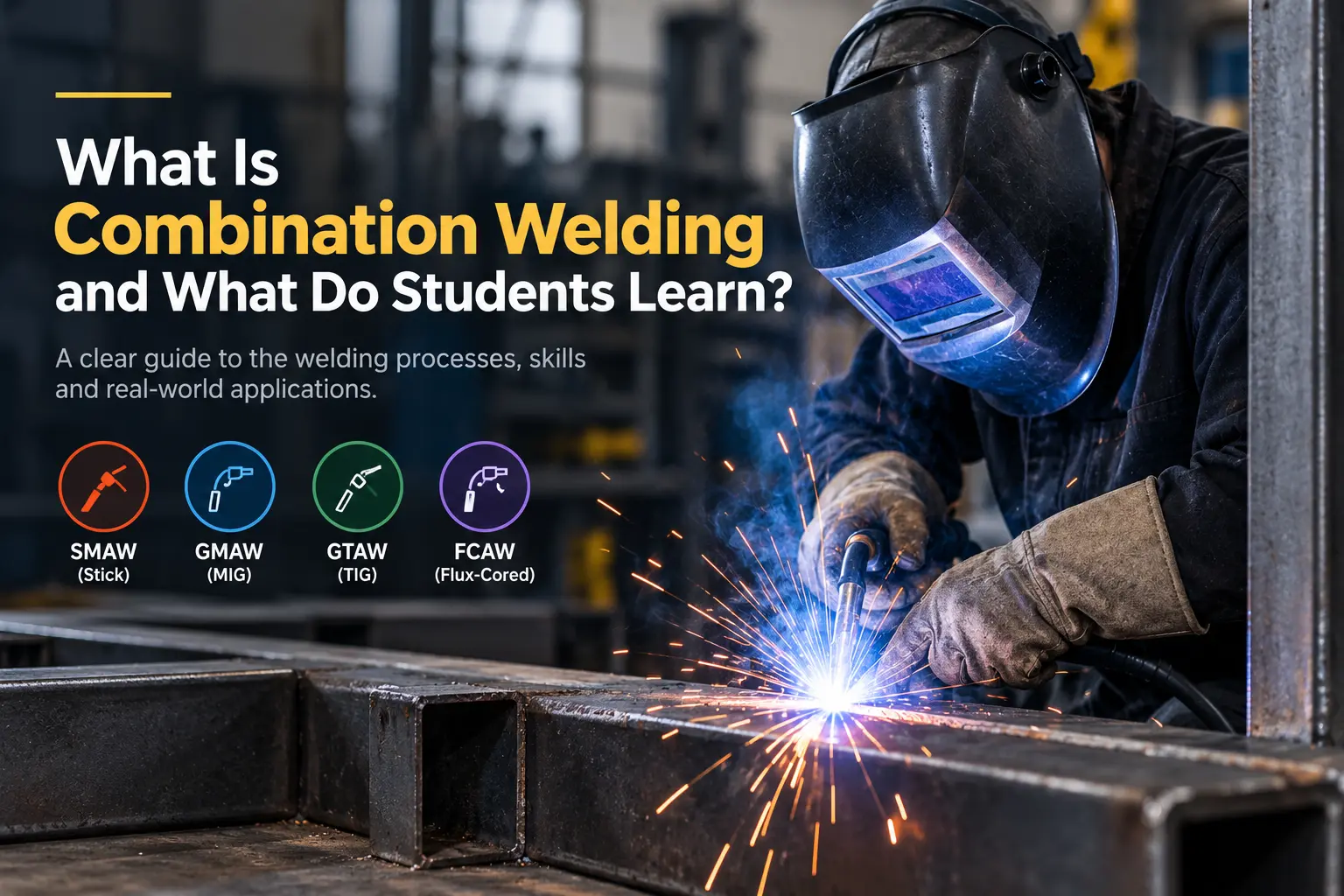
Combination welding is a welding training approach where students learn multiple welding processes, including SMAW (stick welding), MIG/GMAW, TIG/GTAW, FCAW and sometimes pipe welding. Instead of specializing in only one method.
This broader training helps future welders understand how to select the right process, equipment and techniques for different materials, projects and workplace environments.
A combination welding program typically teaches more than welding techniques. Students develop practical skills in welding equipment setup, metal preparation, blueprint reading, welding symbols, joint preparation, safety procedures, weld inspection and quality control. These skills help prepare beginners for entry-level opportunities in industries such as construction, manufacturing, fabrication, industrial maintenance and structural welding.
How Combination Welding Differs From Single-Process Welding
Combination welding focuses on developing versatility across multiple welding methods rather than mastering only one process. A combination welder learns how to evaluate project requirements, select the appropriate equipment, prepare materials and adjust techniques based on the application.
For example, a welder working in fabrication may use MIG welding for efficient production work, while a structural project may require SMAW or FCAW for strength and outdoor conditions. This ability to work with different processes allows welders to adapt to a wider range of workplace environments.
A comprehensive combination welding program may introduce students to these core welding processes:
- Shielded Metal Arc Welding (SMAW): Commonly known as stick welding, this process is widely used in construction, repair work and outdoor applications.
- Gas Metal Arc Welding (GMAW or MIG): A semi-automatic process often used for efficient fabrication and manufacturing projects.
- Gas Tungsten Arc Welding (GTAW or TIG): A precision welding process used when greater control and cleaner welds are required, especially with specialty materials.
- Flux-Cored Arc Welding (FCAW): A process commonly used for structural welding and applications requiring strong weld penetration.
By learning multiple processes, students build a stronger foundation in welding technology, equipment operation and problem-solving, helping them become more adaptable as they enter the welding workforce.
What Does a Combination Welder Do?
A combination welder works with different welding processes and techniques to join metal components. The exact responsibilities depend on the industry, employer and type of project.
Before welding begins, the welder may inspect the materials and prepare the work area. This can include cleaning metal, cutting or shaping components, aligning parts and preparing the joint.
The welder then selects the appropriate equipment and welding process for the task. Machine settings, electrodes, wire, shielding gas and other factors may need to be considered.
After welding, the work may be inspected for quality. The welder may look for visible problems and make adjustments when necessary.
This is why combination welding training focuses on more than simply creating a weld. Students also learn preparation, equipment operation, safety, accuracy and quality control.
What Welding Processes Do Students Learn?
One of the main benefits of combination welding training is exposure to multiple welding processes.
The specific processes taught depend on the curriculum. Students should review the program details of a particular school before assuming that every process is included.
Shielded Metal Arc Welding (SMAW)
Shielded Metal Arc Welding is commonly known as stick welding. It uses an electrode to create an electric arc between the electrode and the workpiece.
Students learning SMAW may practice starting and maintaining an arc. They may also learn electrode selection, machine setup, joint preparation and welding positions.
Stick welding can provide students with a foundation in arc welding and manual welding techniques.
Gas Metal Arc Welding (GMAW or MIG)
Gas Metal Arc Welding, commonly called MIG welding, uses a continuously fed wire electrode and shielding gas.
Students can learn how to set up the welding machine, select appropriate settings, feed the wire and control the welding torch.
The training also focuses on movement, travel speed, positioning and weld consistency.
Learning MIG welding can help students understand how a semi-automatic welding process differs from manual electrode welding.
Gas Tungsten Arc Welding (GTAW or TIG)
Gas Tungsten Arc Welding is commonly called TIG welding. It uses a non-consumable tungsten electrode and can provide precise control over the welding arc.
TIG welding requires careful coordination. Students may practice torch control, filler metal use, material preparation and heat management.
The process can be useful when precision and control are important. However, whether TIG is included in a combination welding program depends on the individual curriculum.
Flux-Cored Arc Welding (FCAW)
Flux-Cored Arc Welding uses a tubular wire electrode containing flux. Depending on the type of FCAW, additional shielding gas may or may not be used.
Students may learn equipment setup, wire selection, travel technique and methods for producing consistent welds.
Exposure to FCAW can add another skill to a student’s welding foundation and help them understand how welding processes differ in equipment and application.
Pipe Welding
Some combination welding programs also provide training related to pipe welding.
Pipe welding requires careful joint preparation and control because the workpiece has a curved surface. Students may practice different welding positions and learn how position affects technique.
Pipe welding can be more demanding than basic flat-position practice. For that reason, hands-on training is especially valuable when pipe welding is part of the curriculum.
What Do Students Learn in a Combination Welding Program?
The central purpose of combination welding training is to build practical and technical welding skills.
Students do not simply learn how to operate a welding machine. They also learn the steps that come before and after welding.
Welding Fundamentals
Training usually begins with basic welding concepts. Students learn common welding terminology, basic principles of heat and arc formation and the purpose of different welding processes.
They also learn how welding variables can affect the finished weld. A strong understanding of fundamentals helps students understand why a welding technique works instead of simply memorizing a procedure.
Welding Equipment Setup
Welding equipment is an important part of practical training. Students learn how to identify and prepare the equipment used for different welding processes. Depending on the program, this may include welding machines, electrodes, wire, shielding gases, torches, leads and related tools.
They may also learn how machine settings influence the welding process. Correct equipment setup is important because incorrect settings can affect weld quality and make the work more difficult.
Joint Preparation
Good welding starts before the arc is created. Students learn how to prepare metal for welding. This may include cleaning the surface, cutting material, preparing edges, fitting components and positioning parts correctly.
Joint preparation can influence penetration, alignment, strength and overall weld quality. Students therefore learn that a successful weld depends on proper preparation as well as welding technique.
Welding Positions and Techniques
Welding is not always performed in the same position. Students may practice flat, horizontal, vertical and overhead welding positions. Pipe welding programs may also introduce additional pipe positions.
Each position requires control and adjustment. Students practice torch or electrode movement, travel speed, angle and positioning. Repeated practice helps them develop consistency.
Hands-on training is particularly important here because welding skills develop through practice and feedback.
Blueprint and Welding Symbol Reading
Some welding programs also teach students how to read basic blueprints and welding symbols.
This skill helps a welder understand what a drawing or specification requires.
Students may learn how to identify dimensions, joint information, measurements and welding symbols.
Understanding technical information can help students move from simply following demonstrations to interpreting real project requirements.
Weld Inspection and Quality
Producing a weld is only part of the job.
Students also need to understand what makes a weld acceptable. Training may introduce visual inspection and basic methods for identifying problems.
Students can learn to look for issues such as poor appearance, inconsistent welds, incorrect dimensions or other signs that a weld may require attention.
Quality control teaches students to evaluate their own work instead of assuming that every completed weld is successful.
What Equipment Do Welding Students Use?
Welding students work with different types of welding equipment depending on the processes included in their program.
Common equipment can include welding machines, welding torches, electrodes, filler materials, wire feeders, shielding gas systems, clamps, grinders and measuring tools.
Students also learn to use personal protective equipment.
A welding helmet protects the face and eyes from hazards associated with welding. Gloves and protective clothing help protect the hands and body.
The purpose of equipment training is not simply to identify tools. Students need to understand how equipment is prepared, adjusted, used and maintained safely.
Why Is Welding Safety Important During Training?
Welding safety is a major part of responsible welding training. Welding can involve heat, sparks, electrical equipment, fumes, compressed gases and other workplace hazards. Students therefore need to learn safe work practices from the beginning.
Personal protective equipment can include a welding helmet, appropriate gloves, protective clothing and other required protective equipment. Ventilation is also important in welding environments. Proper shop practices help control exposure to welding fumes and maintain a safer workspace.
Students also learn the importance of checking equipment before use and following established safety procedures. Safety should not be treated as a separate topic that only appears in a classroom lesson. It should become part of everyday welding practice.
What Skills Can Students Develop Through Combination Welding Training?
Combination welding training can help students develop a broad set of practical skills. These may include:
- Welding equipment operation
- Welding techniques
- Metal preparation
- Joint fit-up
- Welding position control
- Blueprint reading
- Welding symbol recognition
- Weld inspection
- Quality control
- Workplace safety
- Problem-solving
- Precision and consistency
The combination of technical knowledge and hands-on practice is important. A student may understand how a welding process works in theory but still need considerable practice to produce consistent results.
That is why practical welding training is an important part of learning. Students can use repeated practice to improve control, accuracy, equipment handling and confidence.
Where Can Combination Welding Skills Be Used?
Combination welding skills can be useful in several industries and applications. Depending on their training, experience and qualifications, welders may work in areas such as construction, manufacturing, metal fabrication, industrial maintenance, structural welding and pipe-related work.
The specific career opportunities available to a welder depend on factors such as location, employer requirements, experience, qualifications and the welding processes they can perform.
Some employers may also require specific welding certifications or qualifications for particular jobs. For this reason, students should consider both the curriculum and the industry requirements when choosing combination welding training.
Combination Welding vs. Single-Process Welding
The following table highlights the key differences between the two training approaches.
| Feature | Combination Welding | Single-Process Welding |
| Training Scope | Multiple welding processes and techniques | Focuses mainly on one welding process |
| Skills Learned | Broader range of welding skills | Specialized skills in one method |
| Welding Processes | May include SMAW, MIG, TIG, FCAW and pipe welding | Usually focuses on one selected process |
| Career Flexibility | Can provide exposure to different types of welding work | More focused on jobs requiring one specific process |
| Practical Knowledge | Students learn how different processes work and where they are used | Students develop deeper familiarity with one method |
| Best For | Students who want broader welding knowledge | Students with a specific welding process in mind |
Overall, combination welding provides broader exposure to different welding methods. While single-process welding offers more focused training. The right choice depends on the student’s career goals, interests and the type of welding work they want to pursue.
Is Combination Welding Training Right for You?
Combination welding training may be a good option for students who want to develop skills across multiple welding processes.
It can be especially useful for someone who does not want to limit their initial training to one technique. Before enrolling, students should examine the program curriculum carefully.
They should look at the welding processes included, the amount of hands-on training, equipment available, safety instruction, pipe or structural welding components and any certification preparation.
Program length and admission requirements can also vary between schools. The best choice is the program that matches the student’s goals and provides the practical training needed for the type of welding work they want to pursue.
Career Opportunities in Combination Welding
Combination welding training can prepare students for different types of welding work. Because students learn multiple welding processes, they may have more flexibility when looking for entry-level welding jobs.
What Entry-Level Jobs Are Available to Welding Graduates?
- Pipe Welder: Specializes in joining and repairing pipes for oil, gas and utilities.
- Structural Welder: Focuses on fabricating steel structures for buildings, bridges and towers.
- Fabrication Welder: Creates metal products and components in manufacturing and aviation maintenance.
- Underwater Welder: A highly specialized role combining commercial diving with advanced welding skills below the water surface.
What Can Affect a Combination Welder’s Salary?
A combination welding salary can vary based on experience, location, industry, certifications and the type of welding work performed. Welders with stronger technical skills and experience in multiple processes may qualify for a wider range of positions.
For students considering welding as a career, combination welding training can provide a foundation that supports continued skill development and different career opportunities.
Why Texas Students Choose MT Training Center:
- Two Campuses in Major Texas Hubs: We proudly serve the Dallas/Fort Worth Metroplex from our campus in DeSoto, TX, as well as the Greater Houston area through our Humble, TX location.
- Veteran Instructors: You will train side-by-side with highly experienced, professional trade instructors who bring decades of real-world knowledge directly into the workshop.
- Financial Assistance Available: We believe tuition shouldn’t block your career dreams. Financial aid options are available to support qualifying students in achieving their educational goals.
- Comprehensive Certifications: Our structured layout prepares you to test for professional welding certifications, transforming you into a highly appealing candidate for top-tier hiring managers.
Take the First Step Toward Your New Career
Don’t let your career path stall out at position 100. Contact our dedicated admissions team or plan a visit to see our facilities firsthand.
- DeSoto Campus (DFW Area): 100 Ezell Dr, DeSoto, TX 75115 | 972-262-5395
- Humble Campus (Houston Area): 4603 FM 1960 Rd W, Humble, TX 77338 | 346-345-2532
Frequently Asked Questions About Combination Welding
What is a combination weld?
A combination weld refers to welding work where a welder uses more than one welding process or technique. Combination welding training may include processes such as SMAW, MIG, TIG, FCAW and pipe welding. Depending on the program.
What’s the highest paid welding job?
Some of the highest-paying welding careers are found in specialized areas such as underwater welding, pipeline welding, aerospace welding and advanced industrial welding. Pay can vary significantly based on experience, certifications, location, industry and job requirements.
How much do combo welders get paid?
A combination welder’s pay depends on experience, location, certifications, industry and the type of welding work performed. Welders with skills in multiple processes may qualify for a wider range of job opportunities and specialized positions.
Are combination welders any good?
Yes. Combination welders can be valuable because they are trained in multiple welding processes and techniques. This broader skill set can help them work on different projects and adapt to various welding applications.